Rug No. has found its new home.
Every rug we sell is one of a kind, so that piece is gone. Here are others in the same spirit, or tell Rug Finder what you are looking for.
Herki Rugs
Herki rugs on this page are woven in the tradition of the Herki, a Kurdish tribe of the mountain borderlands of northern Iraq and southeastern Turkey. Most Herkis lived as nomads, keeping herds, weaving textiles and carrying goods between countries. Each piece in this collection is one of a kind.


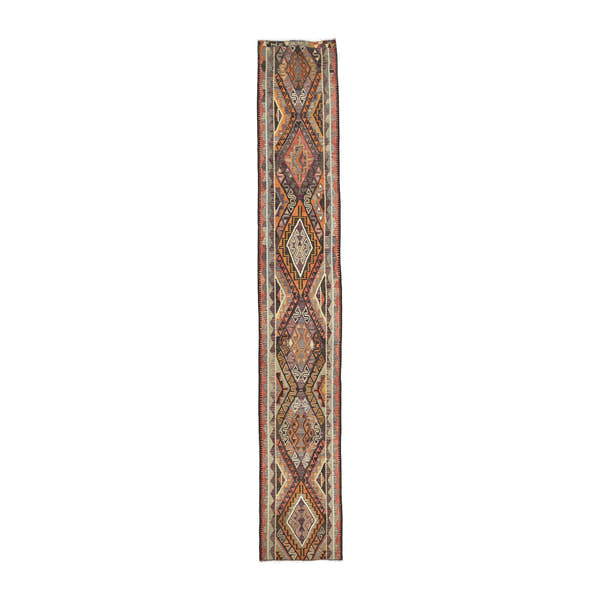
Herki rugs: Kurdish weaving of the mountain borders
The Herki are a Kurdish tribe, Kurmanji speaking, whose communities live in the Kurdistan Region of Iraq and in Hakkari Province in Turkey, among other places along the mountain borders. Most Herkis traditionally lived as nomads who kept herds, wove textiles and carried goods between countries.
Weaving in Iraqi Kurdistan
The Encyclopedia of Crafts of the World Crafts Council Asia Pacific notes that the Kurdish rugs and kilims produced in Iraq are entirely of tribal origin. It names three main weaving areas: the Erbil plain, the country northeast of Erbil, which it calls the center of the Herki, Surchi and Keylani tribes, and the area north of Mosul, known for its kilims.
For nomadic families, rugs and kilims were essential, giving protection from a harsh mountain climate and moving easily as the herds went to new pasture. The encyclopedia notes that Kurdish rugs are woven on fairly narrow looms, often about twice as long as they are wide, and that flat-woven kilims were sometimes made in two matching halves and sewn together into a larger piece. It also records the custom of a Kurdish girl in the countryside weaving a kilim and presenting it to her husband at a shared ceremony, as a sign of hope for their future.
What to look for in a flat weave
In a flat weave the colored wool runs through the weave itself, so motifs are built from straight edges and small steps. Birds, stars and bands come out blocky and bold, the back usually shows the same design as the front, and with no pile the piece lies thin and light on the floor.
Herki among the Kurdish weaves
See the related pieces in our Iraqi rugs and the Kurdish weaving across the border in our Hakkari rugs.
For flat weaves in general, browse our kilim rugs and read the guide to kilim rugs, and for the names and meanings of the common shapes, see reading a rug: motifs and what they mean.
Choosing a size
- Runners: a hall or a galley kitchen. See choosing a runner length.
- Small rugs: an entry, a bedside or a bathroom. See where to put a small rug.
- Room sizes: a living room seating group or a dining table. See choosing the right rug size.
What each listing shows
Every rug page gives the exact size in feet and centimeters, the main colors and a set of photos, including close views. Read the size against the space before you choose, and look at the close views for the small marks of use that come with a handmade rug. If a question is left, we answer by email or phone.
Caring for it
Vacuum gently, turn the rug every few months so sun and traffic reach every side, and blot spills straight away rather than rubbing them. A thin rug pad keeps a rug in place on a hard floor. Our guide to cleaning a wool rug at home has the details.
More on where these rugs come from and how they are made: the Herki guide.
Related collections
Browse Iraqi rugs, kilim rugs and all runners.