Aydin and Fethiye Kilims: Nomad Weaving of Southwest Turkey
In 1988, in a small village mosque near Fethiye, textile researcher Serife Atlihan found kilims of so many different designs that they showed people from many different tribes had settled in that one village.[1] Fethiye and Aydin lie in southwest Turkey, where nomadic Yoruk families once moved their flocks between the coastal plains and the summer pastures in the mountains. Their kilims were woven for life on the move, in dark wool and deep red, with patterns built from diagonal lines.[1] This guide covers both, because the weaving of the two areas shares much of its technique and its people.

The weavers of the southwest
Much of the weaving here belongs to the Yoruk, the nomadic herders of Anatolia. In a museum catalog from George Washington University, textile researcher Serife Atlihan shows Yoruk families on their migration to the Kizilcadag summer pasture above Fethiye, photographed in 1992.[1] Even the tools had local names: the drop spindle known as kirman in much of Anatolia is called tengirek in the Fethiye region.[1]

Around Aydin, art historians Bekir Deniz and Harun Urer studied the Tekeli Yoruk. They place them in the villages of central Aydin, Soke and Didim, and around Selcuk and Kemalpasa in Izmir.[2] In one of those villages, the elders told them their ancestors had arrived around 1865 from the Antalya and Usak regions.[2]
How old the tradition is
The George Washington University catalog includes a long, narrow kilim from western Anatolia, probably Aydin, dated to the first half of the 19th century and measuring 364 by 84 centimeters.[1] Textile researcher Servet Senem Ugurlu illustrates an Aydin prayer kilim from around 1800.[3]

How they are woven
Three flat weaves are common. In the plain kilim, or ilikli kilim, each color travels only inside its own shape and leaves small slits where colors meet. Among the Tekeli near Selcuk, Deniz and Urer heard the slit weave called kilim and the slit-free weave called palaz.[2] The third is zili, where extra pattern yarns are carried over the ground. Atlihan notes that from Canakkale and Balikesir down to Fethiye and Antalya, weavers use the word zili or sili for this kind of patterning.[1]
Among the Tekeli, zili was the most common weave.[2] Their zili floor covers were usually woven in two panels and sewn together, mostly in black sheep’s wool, and their zili prayer rugs often carry a design the weavers call havut, the camel saddle.[2]

How to recognize one
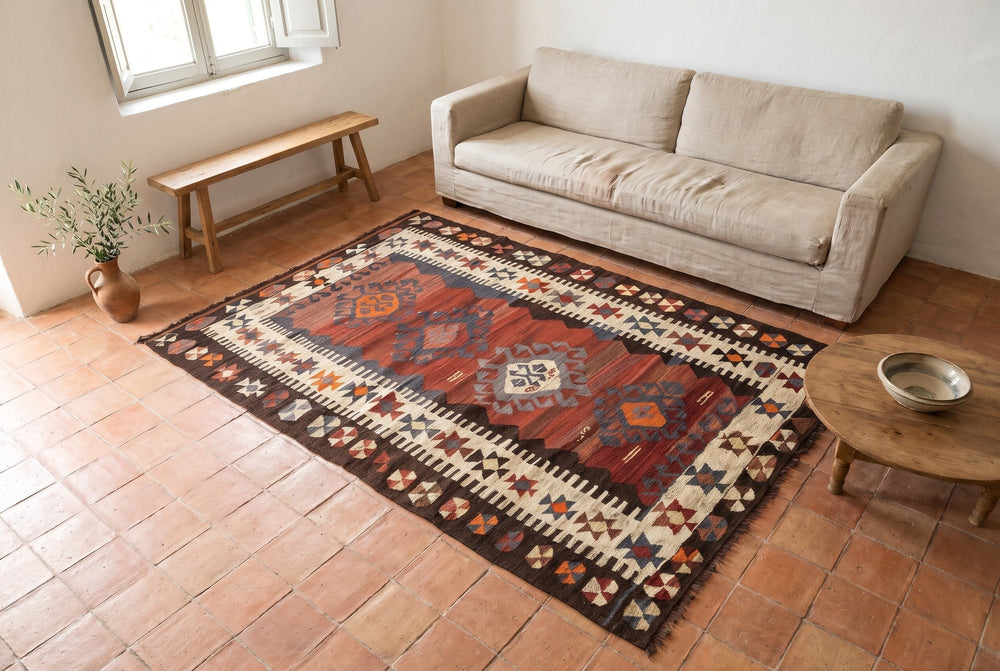
Look at the lines first. A kilim weaver works hard to avoid long slits, so many designs are dominated by diagonal lines, and the edge between field and border is often cut into fingers or saw teeth, called parmak or testere disi.[1]
Then the colors. In the Tekeli weavings near Selcuk, red, brown, navy, blue, black and white dominate, with a little green. The elders told Deniz and Urer these colors came from natural root dyes, though no one in the villages still knew how to make them.[2]
Finally, look at the ends. In the Fethiye region, the eli belinde motif, a woman with hands on hips, appears only at the top and bottom ends of a kilim, and there it is called kral kizi, the king’s daughter.[1]

Fethiye’s pile rugs
Fethiye also has a pile rug of its own. Under the names Fethiye Kaya Halisi, Fethiye Kayakoy Halisi and Fethiye Halisi, it was registered as a geographical indication by the Fethiye Municipality in 2020.[4] If a rug from the area has knots and a soft face, it belongs to that family rather than to the kilims in this guide.

Sizes and prices
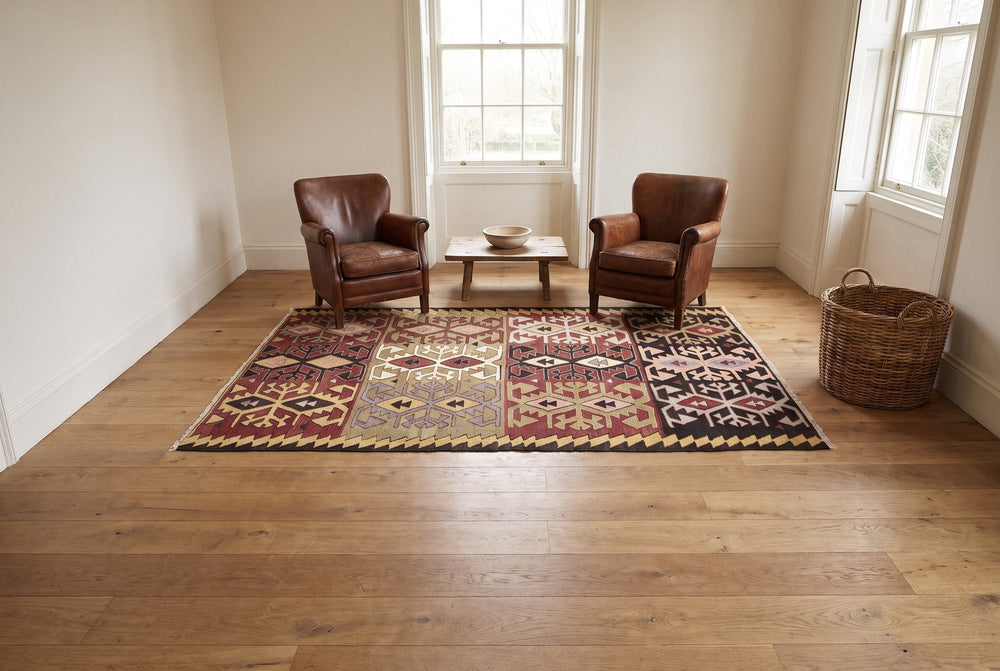
Our Aydin kilims are about 4½ to 5 feet wide and 7 to 7½ feet long. That size fits the foot of a bed, an entry or the space in front of a sofa. The Fethiye pieces run longer, about 5 by 9 feet, which suits a wide hall or a long sofa wall. A handwoven kilim is rarely a perfect rectangle, so check both measurements on the listing.
The Aydin kilims cost about $1,115 to $1,410, and the Fethiye pieces about $1,615.

Living with an Aydin or Fethiye kilim
Dark wool and deep red give a room weight without bulk. These kilims lie thin and flat, so they work under a dining table, in front of a sofa or over a bench, and a long, narrow piece makes a good runner in a hall. A two-panel kilim has a seam down its length; check it now and then and have any loose stitches closed before they spread.
Care is simple. Vacuum it without a beater bar, turn it every few months so light and wear reach every side, and use a thin pad on a hard floor so it stays put. Our guide to cleaning a wool rug at home covers spills and stains.
Where to go next
For flat weaves in general, start with our guide to kilim rugs. The hands on hips figure and the saw-tooth border turn up all over Anatolia, and reading a rug: motifs and what they mean explains the common motifs. To see where a nomadic weaving sits next to village and city rugs, read tribal, village and city rugs, and for the Turkish side of our catalog, the guide to Turkish rugs and the Anatolian rugs guide. You can browse all Turkish rugs and Anatolian rugs.
The kilims themselves are in the Aydin and Fethiye collections, and every flat weave we carry is in the kilim collection.


Sources
- A Nomad’s Art: Kilims of Anatolia, including Serife Atlihan, “Anatolian Kilim Weaving Tradition Today.” The George Washington University Museum and The Textile Museum, 2018.
- Selcuk (Izmir) Civarinda Yasayan Tekeli Yoruklerinde Hali ve Duz Dokuma Yaygilar (Rugs and Flat Weaves of the Tekeli Yoruk near Selcuk, Izmir). Bekir Deniz and Harun Urer, Erdem, 1999.
- Anadolu Kilimlerinde Sanatsal Degerler (Artistic Values in Anatolian Kilims). Servet Senem Ugurlu, Hars Akademi, 2018.
- Fethiye Kaya Halisi, geographical indication no. 598. Turkish Patent and Trademark Office, 2020.