Azilal Rugs: Color on Cream from the High Atlas
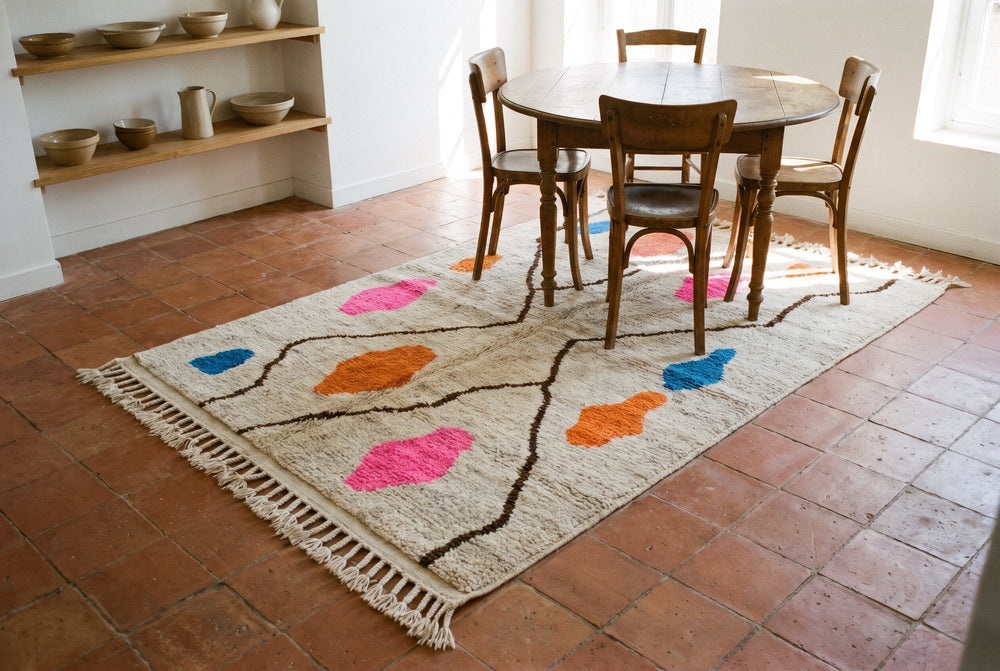
An Azilal rug starts from the same pale wool as the famous Beni Ourain and then does something else entirely. Lines wander, shapes float, and color arrives in patches of pink, orange, blue or yellow, as if the weaver changed her mind halfway across. Where a Beni Ourain is quiet, an Azilal talks.
This guide covers where Azilal is, what makes the style recognizable, how it differs from its cream cousin, and how to live with a rug that has this much going on.

Where Azilal is
Azilal is a city and a province in central Morocco. The national tourist office describes it as lying in the foothills of the Middle Atlas where they meet the High Atlas, and as the capital of the M’Goun area.[1] East of Marrakesh, the M’Goun UNESCO Global Geopark covers part of the central High Atlas around it.[2] UNESCO notes that Azilal itself is home to the Azilal Museum.[2]

The region around it is mountain country, with the Ouzoud waterfalls and the Ait Bouguemez valley among its best known places.[3] In the villages of the geopark, weaving, pottery and other crafts are still part of daily life.[2]

How to recognize an Azilal
Azilal rugs use the same creamy wool as the Beni Ourain, but the drawing is free and moving.[4] Vogue puts it well: even when an Azilal looks simple, every line and shape seems to be in motion.[5] The best of them recall the palette of modern expressionist painting.[5]
Expect a pale ground, dark outlines that wander, and blocks or flecks of color set wherever the weaver wanted them. Symmetry is not the goal. One end of the rug may be busy and the other nearly empty, and a motif may appear once and never again.

Where the colors come from
Moroccan weavers have long dyed with plants: henna for brown, indigo for blue, pomegranate peel for orange and weld for yellow.[6] A museum curator in Marrakesh writes that natural dyes give High Atlas carpets their dominant shades of yellow and orange.[6] Rugs woven today often mix natural and commercial dyes, and the rug page tells you what is known about each piece.
Azilal or Beni Ourain?
Both start from cream wool, and both come from the Atlas. The difference is in the drawing. A Beni Ourain repeats a lattice of dark diamonds, while an Azilal breaks the grid and adds color. If you want a rug that disappears into a calm room, choose the Beni Ourain look. If you want the rug to be the most interesting thing in the room, look at an Azilal.
Pile rugs and flat weaves
Moroccan weavers make flat weaves as well as pile rugs. The hanbel, a word that means weave in the Berber language, is a woven fabric lighter than a carpet.[7] It can stand in for a carpet, or serve as a blanket, a cushion cover or a decoration on feast days.[7] Most of the rugs that reach the market as Azilal are pile rugs, so check the description if you want a thin weave.

Living with an Azilal
An Azilal does best with a little space around it. Pick one or two of its colors for cushions or a throw and leave the rest of the room plain. White walls, pale wood and linen let the drawing breathe, and a single strong chair works better than a crowded set.
Because the pattern is irregular, the rug has no wrong way round. Turn it until the busiest part sits where you look first, by the door or in front of the sofa. Each rug page gives the size in feet and centimeters and says whether the piece is vintage or newly made.
Size matters more with a busy rug than a plain one. A small Azilal in a large room can look like a stray painting on the floor, so choose one big enough to reach under the front legs of the sofa. In a bedroom, a runner-shaped Azilal beside the bed is often enough color for the whole room. In a child’s room or a playroom, the free drawing hides wear and invites a game of following the lines.
The Moroccan rugs we carry now all come from around M’rirt in the Middle Atlas, not from this region. If you like color on cream, look at a cream rug with bold blocks of blue, green, pink and mustard or a cream rug covered in a loose net of mustard lines.

How Moroccan rugs got their names
Many of the names on Moroccan rugs were fixed in the early twentieth century. Under the French protectorate, rural carpets were first sorted into two areas, the Middle Atlas on one side and the High Atlas and the Haouz of Marrakesh on the other.[8] A catalog of Moroccan carpets followed in four volumes, with the Middle Atlas covered in 1926 and the High Atlas and the Haouz in 1927.[8]
In 1919 the protectorate introduced a state seal that guaranteed a carpet’s authenticity and quality.[6] Carpets went on to become a major export, the third most exported good of Morocco up to 1988.[8] Azilal is a place name rather than a tribe, so the label tells you the area a rug comes from, not one village.
Questions people ask
Are Azilal rugs always colorful?
Not always. Some are almost all cream with a few dark lines and a single patch of color. What marks them is the free drawing more than the amount of color.
Can I put an Azilal in a room with a patterned sofa?
It is possible, but the rug is happiest as the only strong pattern. If the sofa is patterned, choose an Azilal with more cream and less color.
Is an Azilal hard to keep clean?
No harder than any wool rug. The pale ground shows dirt sooner than a dark rug, so vacuum regularly and blot spills at once.
Caring for an Azilal
Vacuum a Moroccan pile rug gently with the beater bar off, and turn it every few months so sun and footsteps wear it evenly. A long pile sheds loose fibers for a while, which is normal for wool. Blot a spill with a clean white cloth instead of rubbing it into the pile. How to clean a wool rug at home and do wool rugs shed? cover the rest.
Where to go next
For the difference between the two great rug traditions, read Persian vs. Moroccan rugs. The Moroccan rugs we carry are in the Moroccan rugs collection.
Our other Moroccan region guides cover Beni Ourain, Boujad, Beni Mguild, Beni Mrirt, Marmoucha and Ait Bou Sbaa rugs.


Sources
- Nature and Adventure. Moroccan National Tourist Office.
- M’Goun UNESCO Global Geopark. UNESCO.
- Nature in Azilal. Moroccan National Tourist Office.
- How Beni Ourain Rugs Made It From the Moroccan Mountains to Our Living Rooms. Dwell.
- How to Buy and Style a Vintage Moroccan Rug. Vogue.
- Traditional Dyeing Techniques in Moroccan Amazigh Textiles. Khalid Loukid, National Museum of Weaving and Carpets (Dar Si Said), for ICOM Costume, 2025.
- Pierre Bergé Museum of Berber Arts, room guide. Jardin Majorelle, Marrakech, 2025.
- Weaving and the value of carpets: female invisible labour and male marketing in southern Morocco. Myriem N. Naji, PhD thesis, University College London, 2007.