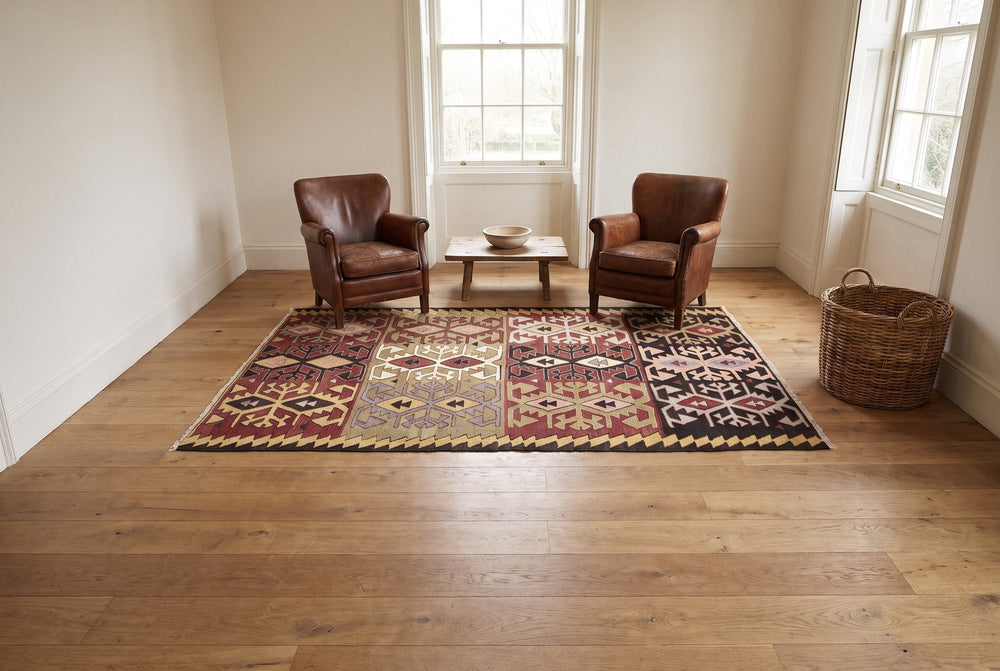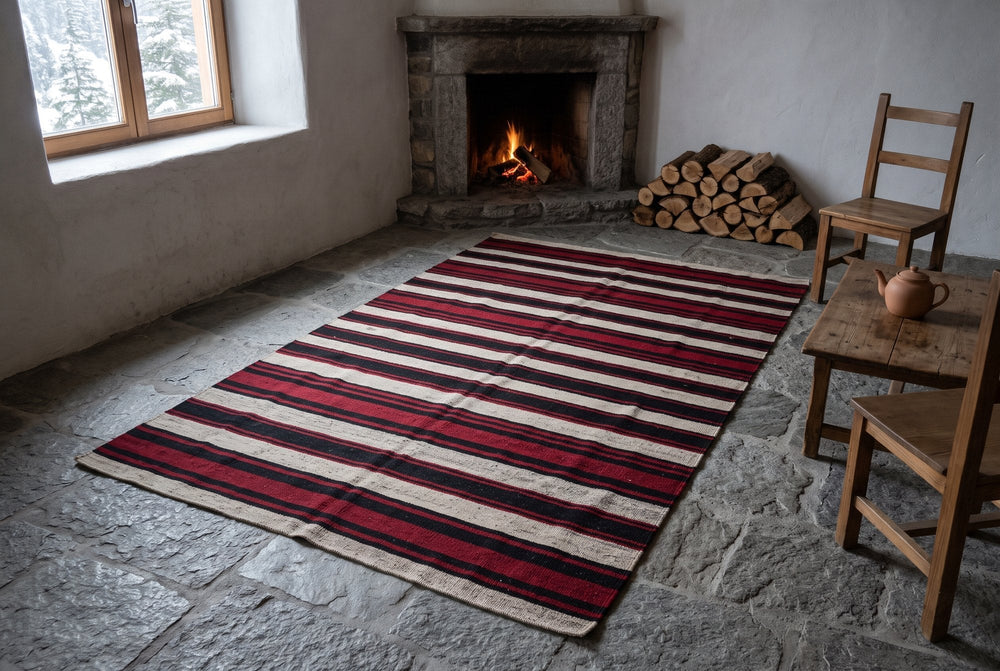
Few people outside Morocco know the name Marmoucha, but a Marmoucha carpet is on show in a museum in Marrakesh. Their country is the eastern end of the Middle Atlas, high and cold, below one of the tallest peaks in the range. They weave thick wool carpets and a flat weave, the hanbel, that is famous in its own right.
This guide covers where the Marmoucha live, what their carpets and hanbels look like and how to use one at home.

Where the Marmoucha live
The town of Imouzzer Marmoucha stands at 1,713 meters, about 5,600 feet, in the Middle Atlas.[1] It marks the end of the Middle Atlas on the side toward Taza.[1] Most of its people belong to the large Marmoucha tribe.[1] The tribe is divided into several fractions, among them the Ait Bazza and the Ait Messaad.[1] The town is surrounded by cedar and oak forest, good country for sheep in summer and hard country in winter.
Above the town rises Jebel Bou Iblane, the second highest peak of the Middle Atlas.[1] The mountains around it have the most severe winter climate in Morocco.[2] A heavy wool carpet here was a matter of comfort, not decoration.

Marmoucha carpets
In the northeast of the Middle Atlas, cream or white grounds dominate among the Marmoucha and their neighbors, the Beni Ouarain, the Beni Alaham and the Ait Seghrouchene.[2] Mountain rugs like these have a high pile, up to about four centimeters, with a coarse knot.[2] The weaver often changed the composition as soon as a new idea came to her.[2]
The Pierre Bergé Museum of Berber Arts in Marrakesh shows a wool carpet from the Marmoucha of the Middle Atlas in its carpet room.[3] The museum’s carpets were given by Pierre Bergé and Bert Flint.[3] Some Marmoucha carpets even carry a woven date: one pile carpet in Gebhart Blazek’s essay is dated 1354 in the Islamic calendar, which is 1933.[2] A date like that is rare, and it shows a weaver marking the year a carpet was finished.


The Marmoucha hanbel
Moroccan weavers make flat weaves as well as pile rugs. The hanbel, a word that means weave in the Berber language, is a woven fabric lighter than a carpet.[3] It can stand in for a carpet, or serve as a blanket, a cushion cover or a decoration on feast days.[3] The Fez regional tourism council lists Boulemane province as famous for its carpets and for the Marmoucha hanbel of the village of Ait Hamza.[4] A hanbel lies thin, so it suits a hall, the space under a table or a bed cover.
How to recognize a Marmoucha piece
A Marmoucha carpet usually looks like a cousin of the Beni Ourain: a pale wool ground with dark drawing. The drawing can be bolder and more blocky, with bands, lozenges and changes of plan along the length. A hanbel is flat, with bands of color and pattern running across it. Names in the Moroccan trade are loose, so treat the label as a guide to the region rather than a guarantee of a single village.

Living with a Marmoucha rug
A deep wool Marmoucha belongs where you stand barefoot: beside a bed, in front of a fire or under a reading chair. A hanbel works where a thick rug would not, under a door or a dining table, or folded at the foot of a bed. Both look best with natural materials around them, wood, linen, stone and clay. Each rug page gives the size in feet and centimeters and says whether the piece is vintage or newly made.
For a deep pile rug, allow a little more room than usual around furniture, because legs sink in and leave marks. Lift and move heavy pieces now and then so the pile can recover. A hanbel, by contrast, can go under the legs of a table or bench without any trouble. Some people use one on a wall or over the back of a sofa, the way it was once used on feast days, and move it to the floor later. Either way, keep it out of strong afternoon sun, which fades dyed wool faster than anything else in a house.
The Moroccan rugs we carry now all come from around M’rirt in the Middle Atlas, not from this region. For a cream rug with bold dark drawing, look at a large cream rug with charcoal blocks set like bricks or a shaggy cream rug with gray and straw blocks.

How Moroccan rugs got their names
Many of the names on Moroccan rugs were fixed in the early twentieth century. Under the French protectorate, rural carpets were first sorted into two areas, the Middle Atlas on one side and the High Atlas and the Haouz of Marrakesh on the other.[5] A catalog of Moroccan carpets followed in four volumes, with the Middle Atlas covered in 1926 and the High Atlas and the Haouz in 1927.[5]
In 1919 the protectorate introduced a state seal that guaranteed a carpet’s authenticity and quality.[6] Carpets went on to become a major export, the third most exported good of Morocco up to 1988.[5] Marmoucha is one of the tribe names on that map, from the eastern end of the Middle Atlas.
Questions people ask
Is a Marmoucha rug the same as a Beni Ourain?
No, though they are neighbors and both often weave cream ground carpets. Treat the two names as two related places in the same mountains.
What is the difference between a hanbel and a kilim?
Both are flat weaves without pile. Hanbel is the Moroccan word, kilim the word used across Turkey and much of the wider region.
Can a hanbel go on the floor?
Yes. Use a thin non-slip pad under it, because a flat weave moves more easily than a heavy pile rug.
Caring for a Marmoucha rug
Vacuum a Moroccan pile rug gently with the beater bar off, and turn it every few months so sun and footsteps wear it evenly. A long pile sheds loose fibers for a while, which is normal for wool. Blot a spill with a clean white cloth instead of rubbing it into the pile. How to clean a wool rug at home and do wool rugs shed? cover the rest.
Where to go next
For the difference between the two great rug traditions, read Persian vs. Moroccan rugs. The Moroccan rugs we carry are in the Moroccan rugs collection.
Our other Moroccan region guides cover Beni Ourain, Azilal, Boujad, Beni Mguild, Beni Mrirt and Ait Bou Sbaa rugs.
Sources
- Imouzzer Marmoucha. Communes et Villes du Maroc.
- Antique Moroccan rugs. Gebhart Blazek, essay first printed in HALI 120, 2002.
- Pierre Bergé Museum of Berber Arts, room guide. Jardin Majorelle, Marrakech, 2025.
- Boulemane. Fez Regional Tourism Council.
- Weaving and the value of carpets: female invisible labour and male marketing in southern Morocco. Myriem N. Naji, PhD thesis, University College London, 2007.
- Traditional Dyeing Techniques in Moroccan Amazigh Textiles. Khalid Loukid, National Museum of Weaving and Carpets (Dar Si Said), for ICOM Costume, 2025.