Beni Ourain Rugs: Cream Wool and Dark Diamonds

Ask someone to picture a Moroccan rug and they will most likely describe a Beni Ourain. It is a deep cream pile with a loose net of dark lines, plain enough to sit under almost anything and soft enough to sit on. The look seems modern, but it began as household weaving in the cold mountains of the Middle Atlas, long before designers took it up.
This guide explains where the name comes from, how to recognize the style, how it reached the living rooms of Europe and America, and what to think about before you buy one.

Where Beni Ourain rugs come from
Beni Ourain is not a town. The name refers to 17 Berber tribes who live in the Atlas Mountains.[1] A curator at Morocco’s National Museum of Weaving and Carpets places the Beni Ouarain confederation, as the name is often spelled, in the Middle Atlas in the northeast of the country, and notes that it is known for its carpets.[2] HALI, the carpet magazine, labels them from the north Middle Atlas.[3]
These are hard mountains. The Middle Atlas rises to about 3,200 meters near Jebel Bou Iblane and has the most severe winter climate in Morocco.[4] Women there wear capes reinforced with strips of wool or cotton to protect them from that climate.[5] A rug in a house like that had a job to do.

Made for warmth, made at home
Moroccan rural carpets were normally used as bedding or blankets, made by women for their own families, with the techniques handed down through the generations.[4] In the mountains they were woven with a high pile and knotted more loosely, so they held off the cold.[4] That is the reason a Beni Ourain feels so deep underfoot.
The work stayed in the home and changed slowly. Berber rugs were traditionally woven by women at home, from wool or recycled textiles, with little changing from one generation to the next.[1] The Beni Ouarain women also weave bridal veils called tarredat, finished with fringes and a resist dye.[2] A rug was one part of a whole household of wool.
How to recognize a Beni Ourain
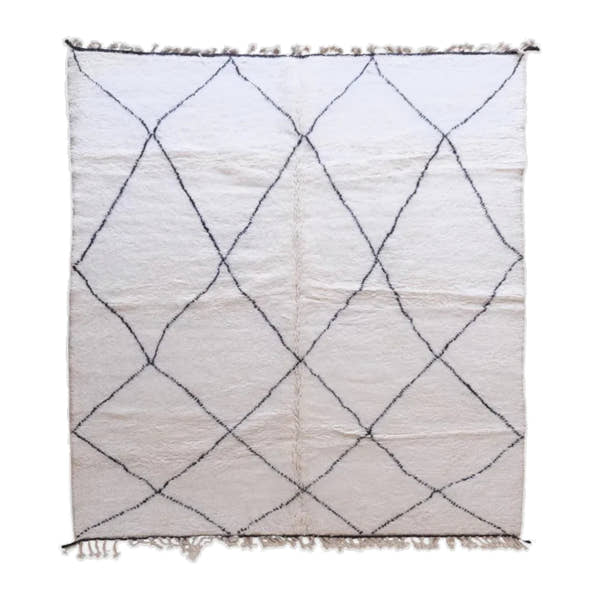
The classic Beni Ourain is a thick, cream-colored pile rug, traditionally made from the wool of the Beni Ourain sheep, with thin black lines crossing to form diamonds.[1] Vogue describes the style as easily known by its classic pattern of simple diamonds.[6]
In the northeast of the Middle Atlas, cream or white grounds dominate among the Beni Ouarain and their neighbors, the Beni Alaham, the Marmoucha and the Ait Seghrouchene.[4] So a cream rug with dark lines is a family resemblance more than a single signature.
Look closely and the lines are rarely ruler straight. A diamond may close neatly and the next one trail open, and a row can drift as it crosses the rug. Some weavers add a few small motifs or a band of color near the ends. The fringe at each end is the warp of the rug itself, not a trim sewn on afterward.
From the mountains to modern rooms
European taste changed around the 1920s, and these weaves suddenly looked modern.[1] Le Corbusier is credited with turning his fellow modernists toward Berber weaving.[1] A 1938 photograph of Frank Lloyd Wright’s Fallingwater in Pennsylvania shows one more such rug.[1]
Vogue calls the Beni Ourain the Moroccan style best suited to a modern, minimal room.[6] A pale wool field calms a busy space, and the dark lines give the eye something to follow without crowding the furniture.

Flat weaves from the same mountains
Moroccan weavers make flat weaves as well as pile rugs. The hanbel, a word that means weave in the Berber language, is a woven fabric lighter than a carpet.[5] It can stand in for a carpet, or serve as a blanket, a cushion cover or a decoration on feast days.[5] You will also see flat-woven pieces sold under the Beni Ourain name, thinner and lighter than the pile rugs and easy to move from room to room.

Choosing a Beni Ourain
Decide first how much pile you want. A long pile is wonderful in a bedroom or beside a sofa, but chair legs sink into it, so it is less happy under a dining table. For a living room, choose a size that lets at least the front legs of the sofa and chairs sit on the rug.
Cream wool will never match a white wall exactly. It is warmer and changes with the light, which is part of its appeal next to wood, linen and stone. Each rug page gives the size in feet and centimeters, the pile and whether the rug is vintage or newly made, so you can compare like with like.
The Moroccan rugs we carry now all come from around M’rirt in the Middle Atlas, not from this region. Two of them come close to the Beni Ourain look: a cream rug crossed by a wide lattice of thin black lines and a large cream rug with charcoal blocks set like bricks.

How Moroccan rugs got their names
Many of the names on Moroccan rugs were fixed in the early twentieth century. Under the French protectorate, rural carpets were first sorted into two areas, the Middle Atlas on one side and the High Atlas and the Haouz of Marrakesh on the other.[7] A catalog of Moroccan carpets followed in four volumes, with the Middle Atlas covered in 1926 and the High Atlas and the Haouz in 1927.[7]
In 1919 the protectorate introduced a state seal that guaranteed a carpet’s authenticity and quality.[2] Carpets went on to become a major export, the third most exported good of Morocco up to 1988.[7] Beni Ourain is one of those tribe names, and today it is also used loosely for almost any cream rug with dark lines, so look at the rug as well as the label.
Questions people ask
Is every cream Moroccan rug a Beni Ourain?
No. Several tribes of the Middle Atlas weave cream ground rugs, and the name is also used for the style in general. The rug page tells you what is known about where a piece was woven.
Will a Beni Ourain work with a dog or children?
Yes, with a little care. Wool is resilient and a cream field hides fluff better than you might think, but a long pile catches crumbs, so vacuum often.
Do the lines have a meaning?
Moroccan carpets carry symbols specific to each region, but the exact meaning has been lost over the centuries, so be wary of anyone who reads a rug for you.
Caring for a Beni Ourain
Vacuum a Moroccan pile rug gently with the beater bar off, and turn it every few months so sun and footsteps wear it evenly. A long pile sheds loose fibers for a while, which is normal for wool. Blot a spill with a clean white cloth instead of rubbing it into the pile. How to clean a wool rug at home and do wool rugs shed? cover the rest.
Where to go next
For the difference between the two great rug traditions, read Persian vs. Moroccan rugs. The Moroccan rugs we carry are gathered in the Moroccan rugs collection.
Our other Moroccan region guides cover Azilal, Boujad, Beni Mguild, Beni Mrirt, Marmoucha and Ait Bou Sbaa rugs.


Sources
- How Beni Ourain Rugs Made It From the Moroccan Mountains to Our Living Rooms. Dwell.
- Traditional Dyeing Techniques in Moroccan Amazigh Textiles. Khalid Loukid, National Museum of Weaving and Carpets (Dar Si Said), for ICOM Costume, 2025.
- Moroccan Carpets and Modern Art in Munich. HALI, 2013.
- Antique Moroccan rugs. Gebhart Blazek, essay first printed in HALI 120, 2002.
- Pierre Bergé Museum of Berber Arts, room guide. Jardin Majorelle, Marrakech, 2025.
- How to Buy and Style a Vintage Moroccan Rug. Vogue.
- Weaving and the value of carpets: female invisible labour and male marketing in southern Morocco. Myriem N. Naji, PhD thesis, University College London, 2007.