Beni Mguild Rugs: Deep Color from the Middle Atlas

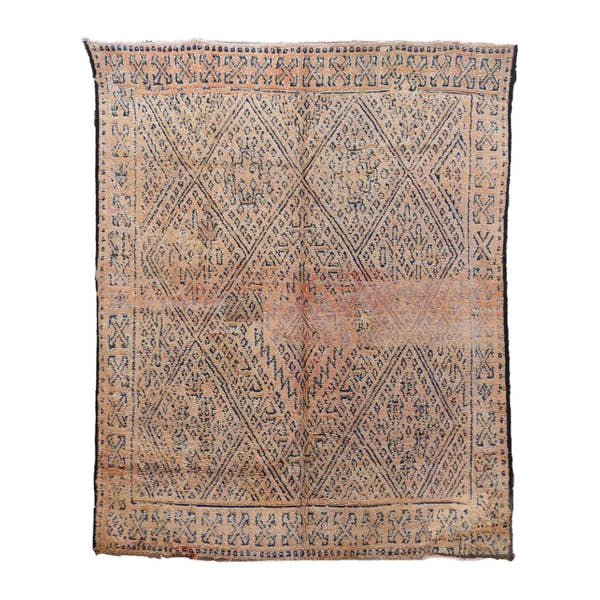
A Beni Mguild rug is the opposite of the cream Moroccan rug most people know. It is dark and saturated, red, magenta, blue or purple, with the color shifting in tone across the field and a fine net of diamonds laid over it. Walk on one and it feels heavy and solid, a mountain rug through and through.
This guide covers the tribe behind the name, where they live, how to recognize their rugs and their remarkable flat weaves.

Who the Beni Mguild are
The Beni Mguild, also written Ait Mguild or Beni M’Guild, are a Berber tribe of the Middle Atlas. The Pierre Bergé Museum of Berber Arts in Marrakesh shows the dress of a woman from the village of Ain Leu, from the Ait Mouli branch of the Ait Mguild.[1] Her cape, the museum notes, is a simple wool covering woven by women.[1]

HALI, the carpet magazine, places Beni Mguild rugs in the central Middle Atlas.[2] This is high, cold country, with cedar and evergreen oak forests across the mountains.[3] The wool for the rugs came from the flocks.
How to recognize a Beni Mguild
Vogue sums up the style: intricate diamond patterns, always on a single color ground that varies in tone, red, magenta, blue or purple.[4] Older pieces tend to look darker, with a high amount of dark blue.[5]
The shifting tone is called abrash, and it comes from wool dyed in separate batches. In a Beni Mguild it is part of the look: the field moves from one shade to the next in long bands, and the fine diamonds keep it from feeling plain. The pile is usually medium to thick, so the rug lies heavy and flat.
Neighbors with similar rugs
The Beni Mguild share the Middle Atlas with the Zemmour and the Zayane. A study of the colonial carpet catalogs notes that the three produce very similar carpets, which were still told apart by tribe name.[6] Vogue adds that Zaiane rugs are very close to Beni Mguild.[4] Do not worry too much about the label; the look is what you live with.

Flat weaves of the Beni Mguild
Moroccan weavers make flat weaves as well as pile rugs. The hanbel, a word that means weave in the Berber language, is a woven fabric lighter than a carpet.[1] It can stand in for a carpet, or serve as a blanket, a cushion cover or a decoration on feast days.[1] The Middle Atlas flat weaves are technically complex and densely decorated.[5] On the western side of the range, some pile carpets of the Beni Mguild even borrow their designs from the flat weaves.[5] One early twentieth-century Beni Mguild hanbel in his essay measures 250 by 145 centimeters, about 8 feet 4 inches by 4 feet 10 inches.[5]
In collections and museums
Beni Mguild rugs have long interested collectors of modern design. In 2013 the International Design Museum in Munich planned an exhibition around the Moroccan carpets of the Munich architect Jürgen Adam, and several of the rugs HALI showed from it were Beni Mguild.[2] The magazine wrote that such rugs take a very modern approach, with bold colors and shapes.[2]


Living with a Beni Mguild
A dark Beni Mguild is a practical rug. It forgives footprints and pets, and its weight keeps it in place under a dining table or a sofa. Pair a red one with cream walls, oak and brass; a blue or violet one with white walls, gray linen and black iron.
Because the color is so strong, the rug can be the only pattern in the room. Keep the upholstery plain and let the diamonds do the work. A deep red Beni Mguild is also one of the few rugs that can hold its own in a dark paneled study or a library with leather chairs. In a bedroom, a blue or violet one under the bed makes the room feel cooler and quieter, which is welcome in a sunny house. The Moroccan rugs we carry now all come from around M’rirt in the Middle Atlas, not from this region, but if you want deep, saturated color, look at a deep red rug with black, blue and yellow blocks or a gold rug divided by thin cream paths. Each rug page gives the size in feet and centimeters and says whether the piece is vintage or newly made.
How Moroccan rugs got their names
Many of the names on Moroccan rugs were fixed in the early twentieth century. Under the French protectorate, rural carpets were first sorted into two areas, the Middle Atlas on one side and the High Atlas and the Haouz of Marrakesh on the other.[6] A catalog of Moroccan carpets followed in four volumes, with the Middle Atlas covered in 1926 and the High Atlas and the Haouz in 1927.[6]
In 1919 the protectorate introduced a state seal that guaranteed a carpet’s authenticity and quality.[7] Carpets went on to become a major export, the third most exported good of Morocco up to 1988.[6] Beni Mguild is one of the tribe names from that time, and it still tells you the part of the Middle Atlas a rug comes from.
Questions people ask
Is Beni Mguild the same as Beni M’Guild or Ait Mguild?
Yes. They are spellings of the same tribal name. We write Beni Mguild on the site.
Does a dark Beni Mguild make a room feel smaller?
Not if the walls are light. A deep rug on a pale floor marks out the seating area and can make a large room feel more settled.
Are the color changes a flaw?
No. Shifts of tone across the field are typical of hand-dyed wool and part of the style.
Caring for a Beni Mguild
Vacuum a Moroccan pile rug gently with the beater bar off, and turn it every few months so sun and footsteps wear it evenly. A long pile sheds loose fibers for a while, which is normal for wool. Blot a spill with a clean white cloth instead of rubbing it into the pile. How to clean a wool rug at home and do wool rugs shed? cover the rest.
Where to go next
For the difference between the two great rug traditions, read Persian vs. Moroccan rugs. The Moroccan rugs we carry are in the Moroccan rugs collection.
Our other Moroccan region guides cover Beni Ourain, Azilal, Boujad, Beni Mrirt, Marmoucha and Ait Bou Sbaa rugs.
Beni Mguild rugs in stock


Sources
- Pierre Bergé Museum of Berber Arts, room guide. Jardin Majorelle, Marrakech, 2025.
- Moroccan Carpets and Modern Art in Munich. HALI, 2013.
- Nature and Adventure. Moroccan National Tourist Office.
- How to Buy and Style a Vintage Moroccan Rug. Vogue.
- Antique Moroccan rugs. Gebhart Blazek, essay first printed in HALI 120, 2002.
- Weaving and the value of carpets: female invisible labour and male marketing in southern Morocco. Myriem N. Naji, PhD thesis, University College London, 2007.
- Traditional Dyeing Techniques in Moroccan Amazigh Textiles. Khalid Loukid, National Museum of Weaving and Carpets (Dar Si Said), for ICOM Costume, 2025.