
A Boujad rug is easy to spot across a room. It is warm before it is anything else, pink, orange and red, with shapes that seem to float on the field rather than sit in rows. It comes not from the high mountains but from the plains, around a small town with a long history as a place of pilgrimage.
This guide explains where Boujad is, who wove there, how to recognize the style and how to give a rug this lively the room it needs.

A town of shrines on the plain
Boujad, also written Boujaad, is a market town in the plains of central Morocco. A 1940s British handbook described it as a place of shrines and regional pilgrimage.[1] The anthropologist Dale Eickelman made it the subject of a classic study of Moroccan Islam.[2]

Eickelman also traveled to the rural markets around the town and learned how the tribal countryside was tied to Boujad.[1] The nearby towns are Oued Zem, Kasba Tadla and Beni Mellal, where the town judge he worked with also sat.[1] Rugs from the surrounding villages came to market there, and the town gave them its name.

The Haouz plains
Boujad sits at the eastern edge of the Haouz, a landscape of hills and plains between the Middle Atlas and the Atlantic.[3] The people of the Haouz are mostly Arab groups and arabised Berbers, and their weaving differs from that of the mountain tribes.[3]
Around Boujad, carpets come close to those of the Middle Atlas in their coarse structure, but the designs do not seem to follow traditional rules.[3] Free floating forms and sharp colors are said to suit the rural taste of the plains.[3]
How to recognize a Boujad
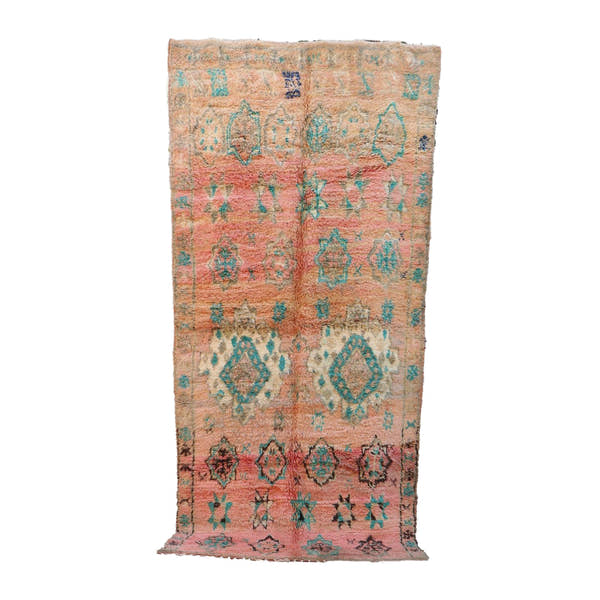
Vogue describes Boujad rugs as often orange and magenta, sometimes pink, with odd floating shapes: squares, rectangles or wobbly diamonds.[4] That is the best short description there is.
Look for a colored field rather than a cream one. The color is rarely flat: it shifts in bands where one batch of yarn ran out and the next began. Shapes are outlined loosely and placed where they fit, with no border to frame them. Two Boujad rugs side by side will share a mood and almost nothing else.
Weavers around Boujad made small pieces too, such as saddle rugs.[3] HALI has written that the rugs of the Maghreb take a very modern approach, with bold colors and shapes.[5] Boujad rugs are the clearest case: hung on a wall, many would pass for an abstract painting.
Sizes and where to put one
Boujad rugs come in every size from small mats to room rugs. A rug around 5 by 8 feet suits a bedroom or a small sitting area; a rug around 8 by 10 feet holds a sofa and two chairs. A long, narrow piece can run beside a bed or down a hall, where the color greets you as you walk in. Under a dining table, allow about 24 inches of rug beyond the table on every side so the chairs stay on it when they are pulled out.


Pile rugs and flat weaves
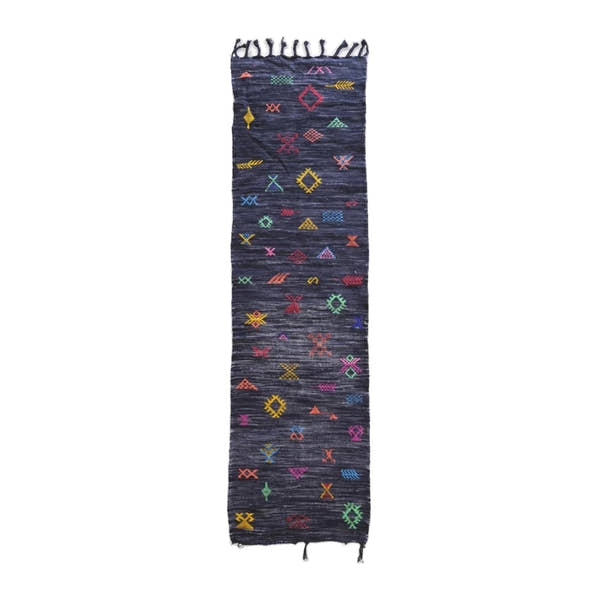
Moroccan weavers make flat weaves as well as pile rugs. The hanbel, a word that means weave in the Berber language, is a woven fabric lighter than a carpet.[6] It can stand in for a carpet, or serve as a blanket, a cushion cover or a decoration on feast days.[6] Flat-woven pieces also come to market under the Boujad name, often striped in the same warm colors. They are thinner than the pile rugs and easy to place under a table or across a hall.

Styling a Boujad
A Boujad likes plain company. White or limewashed walls, natural wood and linen let the pinks and oranges lead. Repeat one of its colors once, in a cushion or a vase, and stop there.
It is a good choice for a room that needs warmth, a north-facing bedroom or a cool white kitchen. Pink is more flexible than it sounds: next to olive green, brown leather or terracotta it reads as a warm neutral. The Moroccan rugs we carry now all come from around M’rirt in the Middle Atlas, not from this region, but a rug of soft salmon shapes and a muted pink rug with lilac and yellow blocks share the warm Boujad mood. Each rug page gives the size in feet and centimeters and whether the piece is vintage or newly made.
How Moroccan rugs got their names
Many of the names on Moroccan rugs were fixed in the early twentieth century. Under the French protectorate, rural carpets were first sorted into two areas, the Middle Atlas on one side and the High Atlas and the Haouz of Marrakesh on the other.[7] A catalog of Moroccan carpets followed in four volumes, with the Middle Atlas covered in 1926 and the High Atlas and the Haouz in 1927.[7]
In 1919 the protectorate introduced a state seal that guaranteed a carpet’s authenticity and quality.[8] Carpets went on to become a major export, the third most exported good of Morocco up to 1988.[7] Boujad is a town name, so the label places a rug on the plains around it rather than in one tribe.
Questions people ask
How do I say Boujad?
Roughly boo-JAHD. You will also see it written Boujaad or Bejaad.
Is a Boujad rug thick?
Usually less than the mountain rugs of the Middle Atlas. The pile varies from rug to rug, and each rug page describes it.
Will the pink fade?
Any wool rug in strong sun softens over time. Turn the rug every few months and use curtains or blinds in a very bright room.
Caring for a Boujad
Vacuum a Moroccan pile rug gently with the beater bar off, and turn it every few months so sun and footsteps wear it evenly. A long pile sheds loose fibers for a while, which is normal for wool. Blot a spill with a clean white cloth instead of rubbing it into the pile. How to clean a wool rug at home and do wool rugs shed? cover the rest.
Where to go next
For the difference between the two great rug traditions, read Persian vs. Moroccan rugs. The Moroccan rugs we carry are in the Moroccan rugs collection.
Our other Moroccan region guides cover Beni Ourain, Azilal, Beni Mguild, Beni Mrirt, Marmoucha and Ait Bou Sbaa rugs.


Sources
- Anthropology in Morocco since the 1960s: A Personal Odyssey. Dale F. Eickelman, Hespéris-Tamuda, 2020.
- Moroccan Islam: Tradition and Society in a Pilgrimage Center (book description). University of Texas Press, via BiblioVault, 1976.
- Antique Moroccan rugs. Gebhart Blazek, essay first printed in HALI 120, 2002.
- How to Buy and Style a Vintage Moroccan Rug. Vogue.
- Moroccan Carpets and Modern Art in Munich. HALI, 2013.
- Pierre Bergé Museum of Berber Arts, room guide. Jardin Majorelle, Marrakech, 2025.
- Weaving and the value of carpets: female invisible labour and male marketing in southern Morocco. Myriem N. Naji, PhD thesis, University College London, 2007.
- Traditional Dyeing Techniques in Moroccan Amazigh Textiles. Khalid Loukid, National Museum of Weaving and Carpets (Dar Si Said), for ICOM Costume, 2025.


