Rug No. has found its new home.
Every rug we sell is one of a kind, so that piece is gone. Here are others in the same spirit, or tell Rug Finder what you are looking for.
Bergama Rugs
Bergama rugs on this page come from the country around Bergama, north of Izmir in western Turkey. The town’s weaving goes back to the 14th century, and from the 16th to the 19th century its rugs were in great demand in Europe. Each rug in this collection is one of a kind.
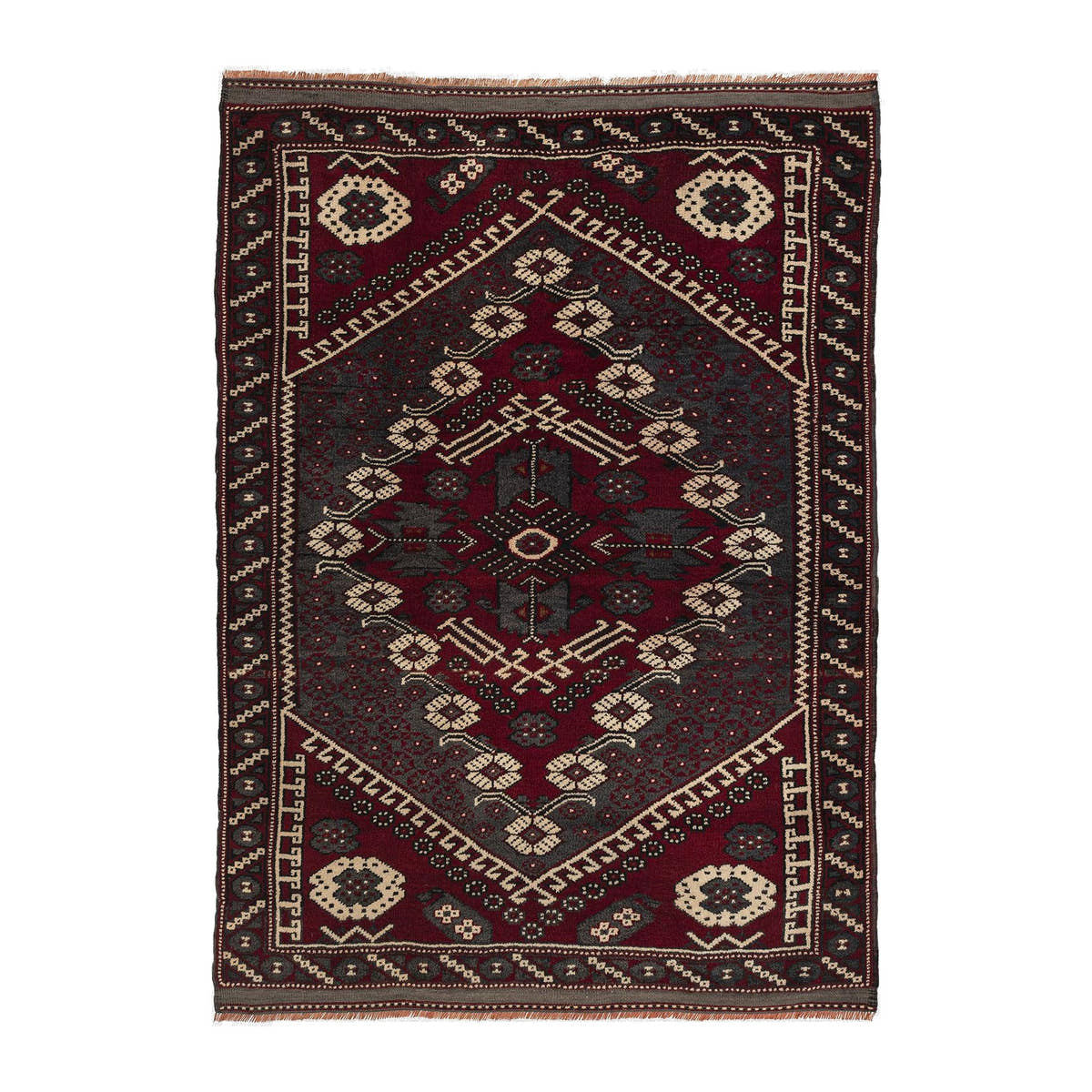

Bergama rugs: a western Turkish name known in Europe
The municipality of Bergama dates the start of its rug weaving to the 14th century, when nomadic tribes first settled in and around the town. From the 16th to the 19th century Bergama rugs were in great demand, and noble families, collectors and even churches in Europe owned them. The Metropolitan Museum of Art notes that large numbers of western Anatolian carpets reached Europe in the 17th and 18th centuries, and that so many were given to churches in Romania and Hungary that the name Transylvanian stuck to them.
European painters put rugs from the region into their pictures, and some designs came to be called after them, among them Holbein, Lotto, Bellini and Memling. In the 19th century almost every house in Bergama had a loom.
Four weaving areas
By place, Turkey’s Ministry of Culture divides Bergama weaving into four areas: Yagcibedir, Karadag, Kozak and Yuntdag. A study published in 1957, cited by the municipality, found that weaving later shrank until it survived only in the villages of Kozak, Yuntdag and Yagcibedir.
How they are made
Rugs, kilims, sacks, saddlebags and prayer rugs are woven on hand looms that local people call istar. Wool from local sheep is spun and plied by hand and colored with plant dyes, which the ministry credits for the long-lasting brightness of Bergama rugs. The pile is tied with the Gordes, or Turkish, knot, and the registered standard for a Bergama hand-woven carpet sets warp, weft and pile all in wool, with a pile of 7 to 10 millimeters.
The girl’s Bergama
The best-known story belongs to a type called Kiz Bergama, the girl’s Bergama. In the legend, the son of a chief between Bergama and Dikili sees a girl at a spring and falls for her, the match ends in a feud between the two families, and the girl, parted from him for good, weaves her grief into her rug.
Bergama among the Turkish weaves
Compare these rugs with our Yagcibedir rugs, one of the four Bergama areas, the Manisa rugs to the south, and the village rugs in our Anatolian collection.
For the wider picture, read the guide to Turkish rugs and the Anatolian rugs guide, and see tribal, village and city rugs for how the three traditions differ.
Choosing a size
- Runners: a hall or a galley kitchen. See choosing a runner length.
- Small rugs: an entry, a bedside or a bathroom. See where to put a small rug.
- Room sizes: a living room seating group or a dining table. See choosing the right rug size.
What each listing shows
Every rug page gives the exact size in feet and centimeters, the main colors and a set of photos, including close views. Read the size against the space before you choose, and look at the close views for the small marks of use that come with a handmade rug. If a question is left, we answer by email or phone.
Caring for it
Vacuum gently, turn the rug every few months so sun and traffic reach every side, and blot spills straight away rather than rubbing them. A thin rug pad keeps a rug in place on a hard floor. Our guide to cleaning a wool rug at home has the details.
More on where these rugs come from and how they are made: the Bergama guide.
Related collections
Browse all Turkish rugs, Manisa rugs and kilim rugs.