Rug No. has found its new home.
Every rug we sell is one of a kind, so that piece is gone. Here are others in the same spirit, or tell Rug Finder what you are looking for.
Kilim Rugs
Kilim rugs on this page are flat woven, with no pile, so they lie thin and light on the floor. Most Anatolian kilims are slit woven, a technique that gives their patterns crisp, stepped edges. Each rug in this collection is one of a kind. Each page says where the kilim comes from and how it is woven.


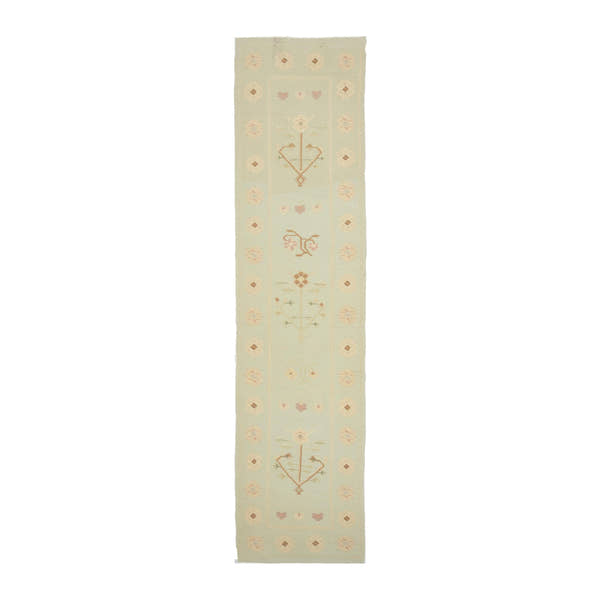


Kilim rugs: flat weaves from Anatolia and beyond
A kilim is made by tightly interweaving warp and weft to give a flat surface with no pile. Without knotted tufts, a kilim is thinner and lighter than a pile rug, easy to lift, turn and move from room to room.
Most Anatolian kilims are slit woven. Where two colors meet along a vertical line, the weaver turns each weft back around its own warp, leaving a small slit, which is why kilim patterns favor diagonals, steps and diamonds. Larger old kilims were often woven in two or three sections on small horizontal floor looms, the kind a nomadic household could move, and then sewn together, so a seam down the middle is part of how they were made.
Reading the patterns
Some kilim motifs carry names and stories. The elibelinde, for example, is a stylized female figure. Other motifs repeat a handful of shapes: diamonds, hooks, stars and stripes, set in bands or in a lattice across the field. Village weavers worked from memory rather than from a pattern on paper, so no two kilims are quite alike.
Where our kilims come from
Most of our kilims are Turkish, from regions such as Konya, Kars and the rest of Anatolia. Others come from the Balkans and beyond, and each page names the place of origin. For the history and the techniques behind them, read our guide to kilim rugs.
For the wider picture, read the guide to Turkish rugs and the Anatolian rugs guide, and see tribal, village and city rugs for how the three traditions differ.
Choosing a size
- Runners: a hall or a galley kitchen. See choosing a runner length.
- Small rugs: an entry, a bedside or a bathroom. See where to put a small rug.
- Room sizes: a living room seating group or a dining table. See choosing the right rug size.
What each listing shows
Every rug page gives the exact size in feet and centimeters, the main colors, how the rug is woven and a set of photos, including close views. Read the size against the space before you choose, and look at the close views for the small marks of use that come with a handmade rug. If a question is left, we answer by email or phone.
Living with a kilim
A kilim brings a graphic, handmade look to a room. It sits close to the floor, so it works under a dining table where chairs slide in and out, at the foot of a bed, or layered over a larger rug. It can also hang on a wall.
Caring for it
Vacuum gently without the beater bar, turn the rug every few months so sun and traffic reach every side, and blot spills straight away rather than rubbing them. A thin rug pad keeps a rug, and a flat-woven kilim above all, from sliding on a hard floor. Our guide to cleaning a wool rug at home has the details.
Related collections
Browse all Turkish rugs, Anatolian rugs, Balkan rugs and kilims and small rugs.