Rug No. has found its new home.
Every rug we sell is one of a kind, so that piece is gone. Here are others in the same spirit, or tell Rug Finder what you are looking for.
Poturge Rugs
Poturge rugs on this page are kilims from Puturge, also spelled Poturge, a district of Malatya Province in eastern Turkey. They belong to the kilim weaving of Malatya, known for naturally dyed wool and many-colored designs built from linked panels. Each piece in this collection is one of a kind.
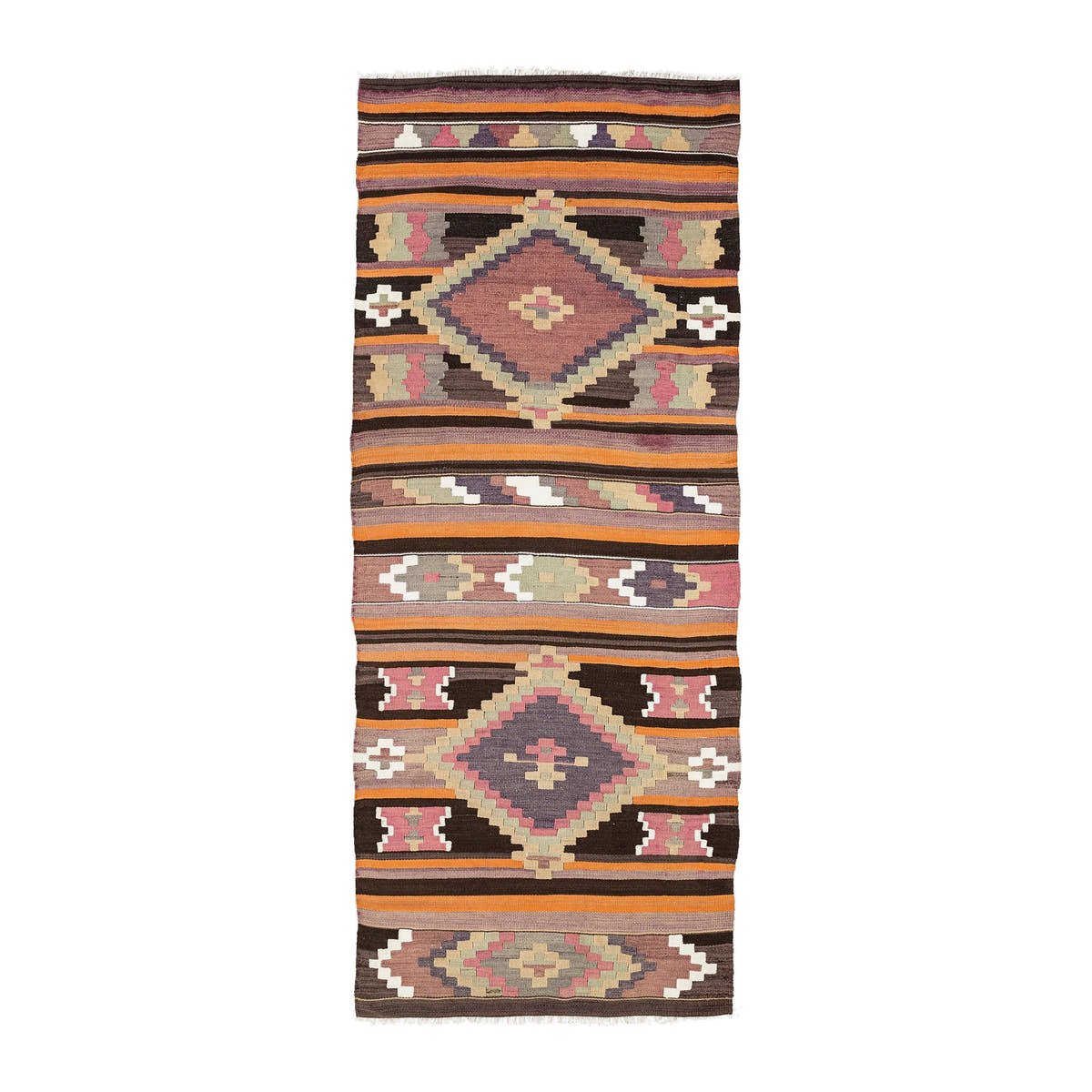


Poturge rugs: kilims of Malatya Province
Puturge is one of the districts of Malatya, and written studies of the weaving of Puturge itself are few. What follows describes the kilim tradition of the province it belongs to.
In a 2022 study of Malatya kilims, Songul Aral of Inonu University writes that the kilims of the province appear in museums and in collections abroad, and that one mark setting them apart from other Anatolian kilims is that many were woven in large sizes. Their designs come from naturally dyed yarn, with lively shifts of color from motif to motif. Kilim weaving there began with the simple flat weaves of the black goat hair tents of the highland tribes, and grew more colorful inside the tent, in floor covers, sacks and hangings.
Reading a Malatya kilim
- Named by design: weavers and the market know Malatya kilims by names such as palas, sandikli or gollu, Dirican gozu ak, harar, cibikli or cizgili for the striped kind, and sakli, the winged or window kilim.
- No center medallion: instead of one medallion, large linked motifs repeat across the field. Locally a square compartment is called a sandik, or chest, and a many-sided one a gol, or lake.
- Small flowers: small four-leafed shapes scattered around the compartments are called roses, and in some villages birds.
- Color: older pieces were dyed with plants gathered in the highlands, and orange is used heavily in some kilims, including those of the Dirican tribe.
- Slits: Malatya weavers call the slit kilim yarma, and design the pattern so that no slit runs longer than 1 centimeter.
What to look for in a flat weave
In a flat weave the colored wool runs through the weave itself, so motifs are built from straight edges and small steps. Diamonds, stars and bands come out bold, the back usually shows the same design as the front, and with no pile the piece lies thin and light on the floor.
Poturge among the Turkish weaves
See the wider province in our Malatya rugs, and the village weaving of the east in our Anatolian collection.
For flat weaves in general, browse our kilim rugs and read the guide to kilim rugs, and for the names and meanings of the common shapes, see reading a rug: motifs and what they mean.
Choosing a size
- Runners: a hall or a galley kitchen. See choosing a runner length.
- Small rugs: an entry, a bedside or a bathroom. See where to put a small rug.
- Room sizes: a living room seating group or a dining table. See choosing the right rug size.
What each listing shows
Every rug page gives the exact size in feet and centimeters, the main colors and a set of photos, including close views. Read the size against the space before you choose, and look at the close views for the small marks of use that come with a handmade rug. If a question is left, we answer by email or phone.
Caring for it
Vacuum gently, turn the rug every few months so sun and traffic reach every side, and blot spills straight away rather than rubbing them. A thin rug pad keeps a rug in place on a hard floor. Our guide to cleaning a wool rug at home has the details.
Related collections
Browse all Turkish rugs, kilim rugs and Anatolian rugs.