Hakkari Kilims: Dark, Dense Tribal Weaving from Southeast Turkey
In Hakkari, in the mountains of Turkey’s far southeast, lambs are shorn at shearing festivals every year, and their wool is spun by hand into a single yarn before it ever reaches the loom.[2] The kilims that come off those looms are dark, dense and covered in small motifs with names of their own: Sarya’s rose, the wolf’s mouth, the earring, the scorpion.[2] A Hakkari kilim is a flat weave with no pile. The pattern is built from the weft, and the back looks the same as the front.[1]

Where Hakkari kilims come from
Hakkari kilim is a registered geographical indication in Turkey, granted to the Hakkari Chamber of Commerce and Industry in 2023. The registration describes kilims woven from yarn spun from the wool of sheep and lambs fed on the high pastures.[2]
The wool comes with a local custom. After the yearly shearing festivals, the wool is washed and combed, then spun into a single-ply yarn on a hand spindle before it goes to the loom.[2]

Hakkari kilims are close cousins of the kilims of neighboring Van. Textile researcher Mine Taylan describes Van and Hakkari kilims as tribal kilims with dark colors and dense designs, known by local names.[3] She also notes that the two are very hard to tell apart, because the tribes who weave them live in both provinces.[3]
How to recognize a Hakkari kilim
Most Hakkari kilims are woven in one piece on upright iron looms, in the slit technique.[2] In that technique each colored weft travels back and forth only inside its own shape and turns where the next color begins. Many Hakkari weavers then outline the shapes with a wrapped yarn in a contrasting color, which gives each motif a crisp edge.[1]
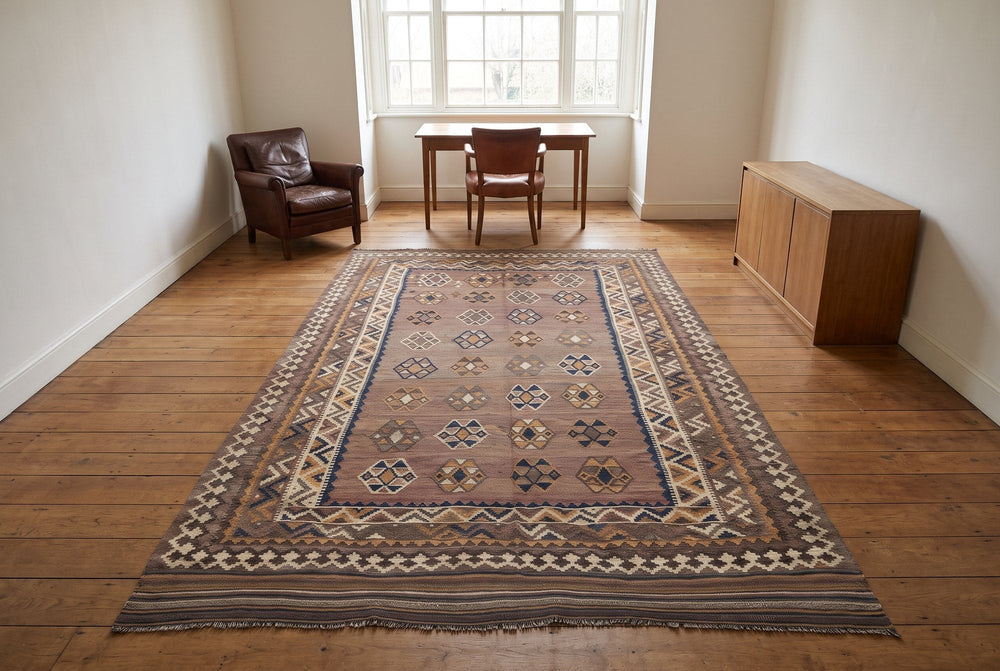
Scale is the next clue. Where Van and Hakkari kilims do differ, Hakkari motifs tend to be smaller and set closer together, and Van motifs larger and more widely spaced.[3] From a few steps away, a Hakkari kilim reads as a dense, dark field rather than a few big shapes.
Then turn it over. A kilim has no knots and no pile, so the back shows the same pattern in the same colors. If one face is fuzzy and the other shows rows of knots, it is a pile rug, not a kilim.

The motifs you will see
The geographical indication lists the motifs expected on a Hakkari kilim and gives each one a meaning. These readings come from the registration; weavers did not leave a written key. Several of the motifs have names that belong to the region.[2]
- Sarya’s rose: Sarya is a woman’s name often heard in Hakkari, and the first kilim of this name is said to have been woven by a woman called Sarya. The same figure, a woman with hands on hips, is called eli belinde elsewhere, and the registration reads it as motherhood, joy and good fortune.
- Kurtagzi, the wolf’s mouth: a row of teeth set between the border and the field, read in the registration as a guard.
- Kupe, the earring: read as a young woman’s wish to marry, and found most in the borders of dowry kilims.
- Akrep, the scorpion: read as protection from harm.
- Kocboynuzu, the ram’s horn: read as plenty, courage and strength.
- Lapik, the glove: the local name for the hand, finger and comb motifs, read as strength and authority.[2]
Whole designs take local names too, and the Herki kilims, for example, are mostly gray, black and navy.[1]
What colors Hakkari kilims come in
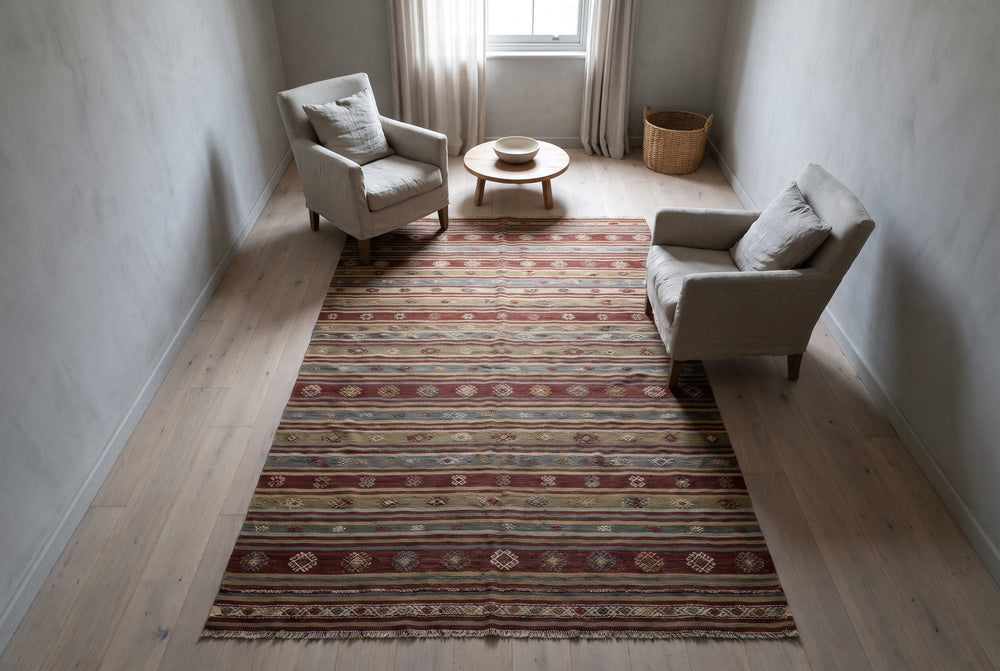
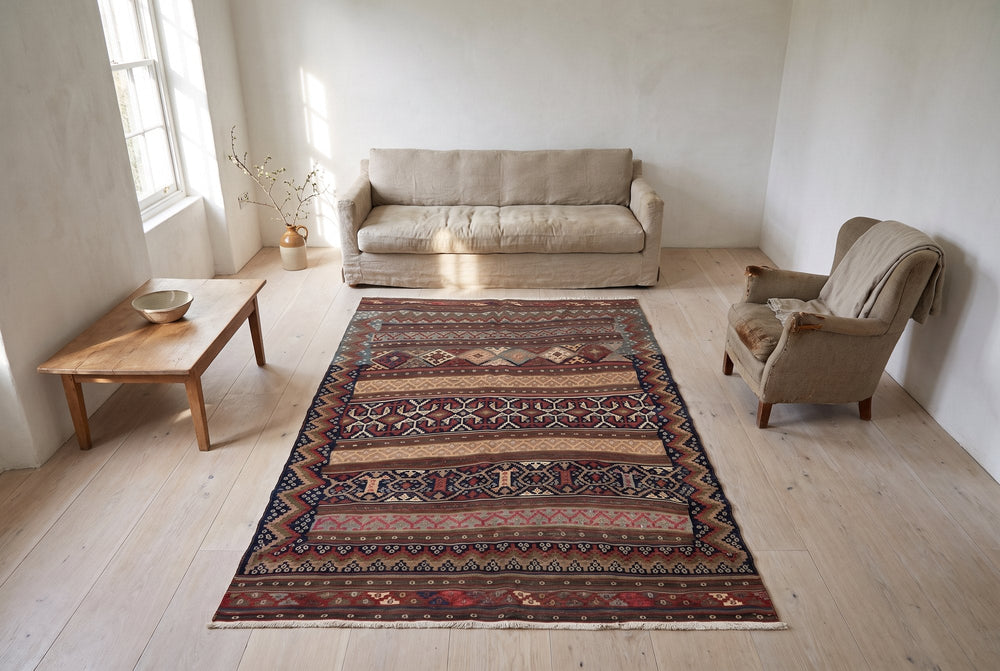
The colors used most in Hakkari kilims are red, burgundy, navy, brown, black and white, with green, yellow and blue in a smaller role.[1] The overall effect is dark: deep red and navy grounds, with white and yellow used sparingly so they stand out.
There are practical reasons for the dark palette. Taylan points out that dark colors do not show dirt.[3] Guler Yilmaz, in a study of prayer rugs found in Hakkari, adds the climate: cold, snowy winters steered weavers toward dark colors.[4]

A design that is never woven twice
Hakkari weaving is not frozen in the past. In the kilim workshops of the Hisar Anatolian Support Society in neighboring Van, weavers between 2010 and 2020 began improvising a new design called asiret kavgasi, the tribal fight.[3] Taylan describes how each weaver builds it at the loom from the traditional motifs of the region, adding stylized people, animals and flowers as she goes.[3] Because it is improvised, an exact copy of a finished kilim cannot be made again, so every tribal fight kilim is one of a kind.[3]
Sizes
The Hakkari kilim in the picture here is 5 feet 1 inch by 7 feet 11 inches, wide enough for the foot of a bed or the middle of a sitting area. A flat weave lies thin, so a chair or a table can stand on it without rocking. You can see it on its product page.
Living with a Hakkari kilim
A dark kilim gives a floor weight without the bulk of a pile rug. Deep red, navy and brown sit well with plain plaster walls, oak and leather, and the small, dense motifs read as texture from across the room. Because a kilim lies thin and close to the floor, it works where a thick rug would not: under a door that swings, below a desk chair that slides, or on a bench.

Care is simple. Vacuum it without a beater bar, turn it every few months so light and wear reach every side, and use a thin pad on a hard floor so it stays put. Our guide to cleaning a wool rug at home covers spills and stains.
Where to go next
For flat weaves in general, start with our guide to kilim rugs. The motifs above have cousins across Anatolia, and reading a rug: motifs and what they mean explains the common ones. To see where a tribal weaving sits next to village and city rugs, read tribal, village and city rugs, and for the Turkish side of our catalog, the guide to Turkish rugs and the Anatolian rugs guide. You can browse all Turkish rugs and Anatolian rugs.
Our Hakkari kilims are gathered in the Hakkari collection, flat weaves from across Turkey are in the kilim collection, and for another weaving region of eastern Turkey, read the Kars rugs guide.


Sources
- Hakkari Kilimciligi Uzerine Bir Arastirma (A Research on Hakkari Rug Weaving). Muhammed Mustafa Guldur and Zekiye Senturk, Kalemisi, 2015.
- Hakkari Kilimi, geographical indication no. 1356. Turkish Patent and Trademark Office, 2023.
- A New Design in Van-Hakkari Kilims: Tribal Conflict. Mine Taylan, Motif Akademi Halkbilimi Dergisi, 2020.
- 20th Century Prayer Rugs Detected in Hakkari. Guler Yilmaz, SDU ART-E, 2022.