Rug No. has found its new home.
Every rug we sell is one of a kind, so that piece is gone. Here are others in the same spirit, or tell Rug Finder what you are looking for.
Bijar Rugs
Bijar is in Kurdistan in western Persia, and its rugs are famous for one thing: weight. The wefts are beaten down so hard that the finished rug is stiff and remarkably dense, which is why they are sometimes called the iron rugs of Persia.
That build is also why they last. Most of what we have here is accent size, with a larger carpet or two. Each was knotted around fifty years ago and is one of its kind.
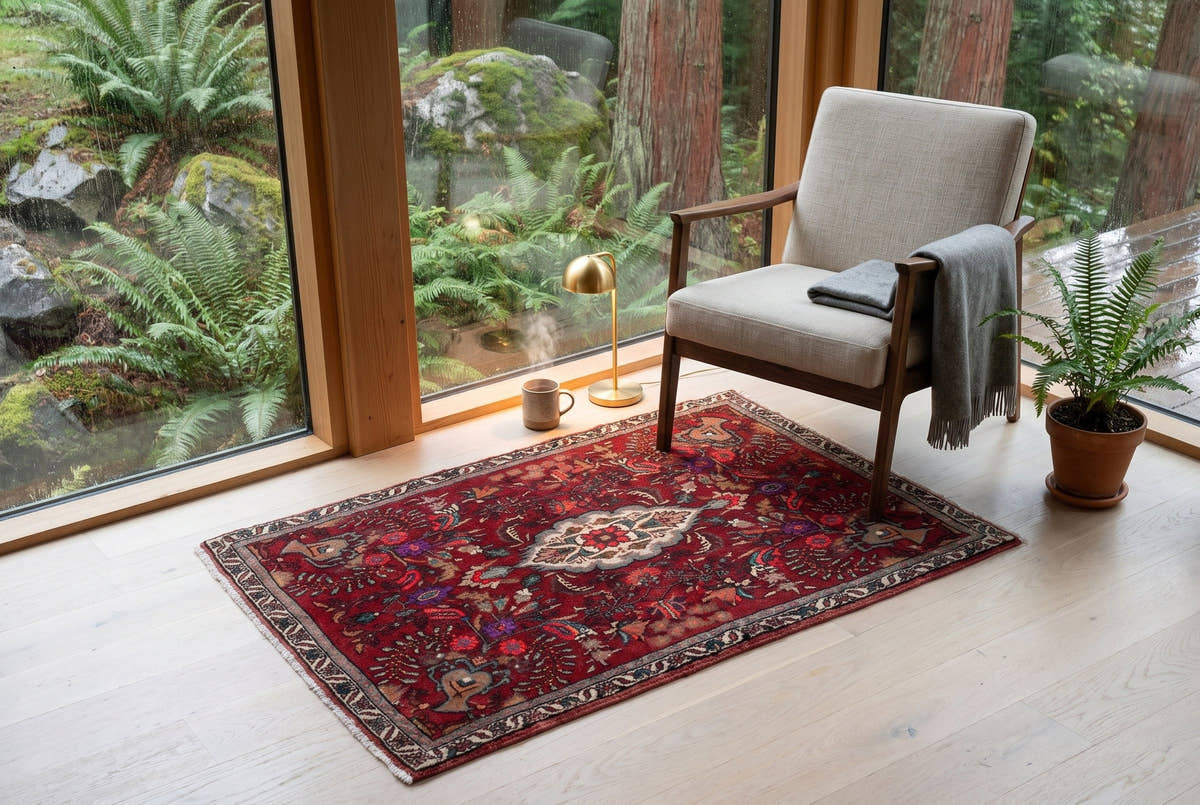


Bijar: the heaviest weave in Persia
Bijar is a Kurdish town in western Persia, northeast of Sanandaj, and its carpets are unlike anything else woven in the country. The weavers beat the wefts down with a heavy metal comb while the rug is still under tension on the loom, packing the structure so tightly that the finished carpet is stiff enough to stand on its edge. The trade nickname, the iron rug of Persia, is not marketing.
That construction is why Bijar carpets last. They resist crushing, they hold their shape, and an old Bijar often has more pile left than a far younger rug from a lighter weaving town.
How to recognize a Bijar
- Drawing: Herati fish pattern, stylized medallions, and sometimes a plain open field with a strong border.
- Color: deep madder red, indigo, camel and ivory, often with a rose tone that softens with age.
- Construction: exceptionally dense, wool on cotton, rigid and heavy, with a low, tightly packed pile.
- Sizes: this collection is mostly accent size, which is where Bijar weight is easiest to live with.
Small rugs for hard wear
A small Bijar works where a rug takes concentrated wear: beside a bed, in front of a sink, at the foot of a stair. The density means it will not ripple or crush in a doorway the way a softer rug does.
They also sit well on top of other floor coverings, because the stiffness keeps the edges flat without a pad.
A word about weight
A Bijar is genuinely heavy for its size, and it does not fold easily. This is worth knowing before it arrives, and it is also the real reason these rugs survive. If you want something light and drapey, a Bijar is the wrong choice; if you want something that will outlast the room, it is the right one.
Your Bijar questions
Why is a Bijar so stiff?
The wefts are compressed with a weighted comb during weaving, which locks the knots in place. It is a construction method rather than a treatment, so the stiffness is permanent.
Will a Bijar lie flat?
Usually yes, and better than most rugs, because the structure resists curling. After shipping, an older one may need a few days to relax completely flat.
Is Bijar Kurdish or Persian?
Both. Bijar is in Persia and the carpets are Persian, and the weavers of the district are Kurdish. The two are not in conflict.
Where to start
Look at the ground color first and the border weight second, since Bijar borders carry a lot of the design. All of them are vintage singles, cleaned by long-trusted specialists before they were listed.
Why Bijar earned the name iron rug, and how to look after one: the Bijar guide.