Rug No. has found its new home.
Every rug we sell is one of a kind, so that piece is gone. Here are others in the same spirit, or tell Rug Finder what you are looking for.
Manisa Rugs
Manisa, in Turkey’s Aegean west, sits in Anatolian weaving country: town and village rugs with soft, faded color and a relaxed, geometric hand. They carry the soft, unfussy character of western Turkish weaving. Every Manisa here is an original vintage piece, decades old and the only one of its kind.
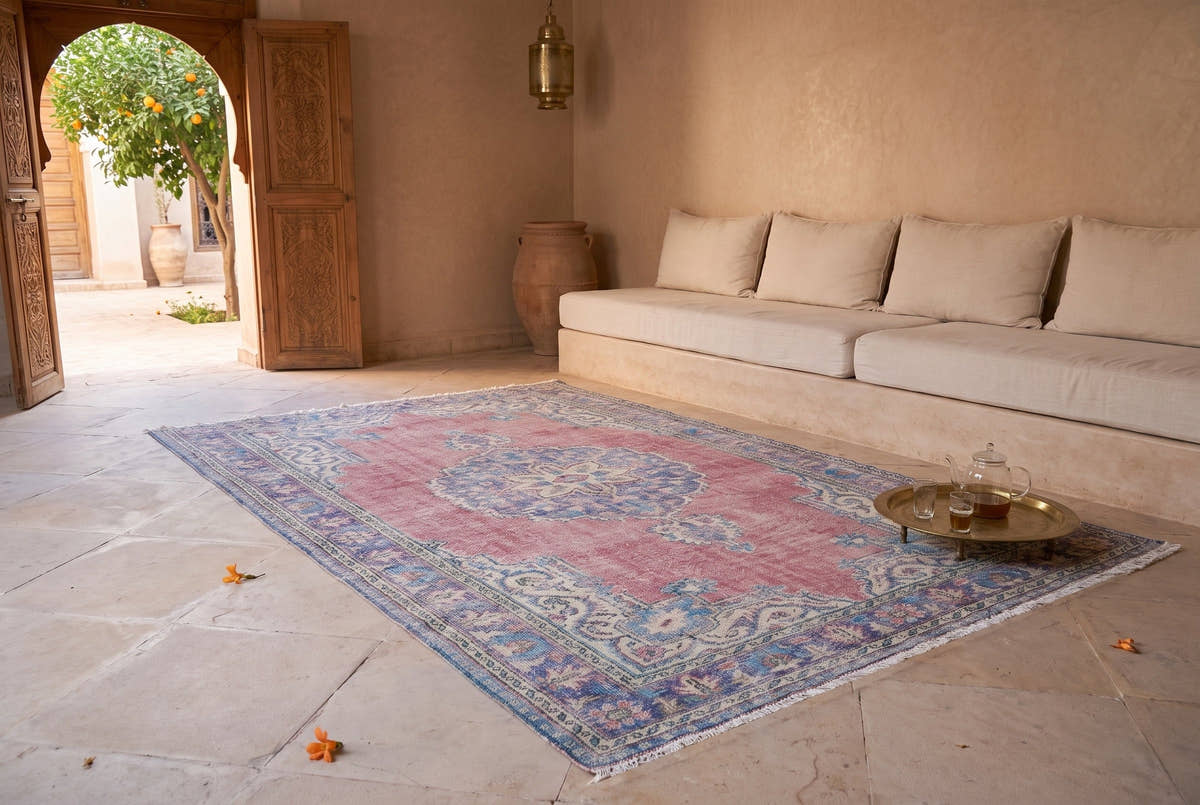


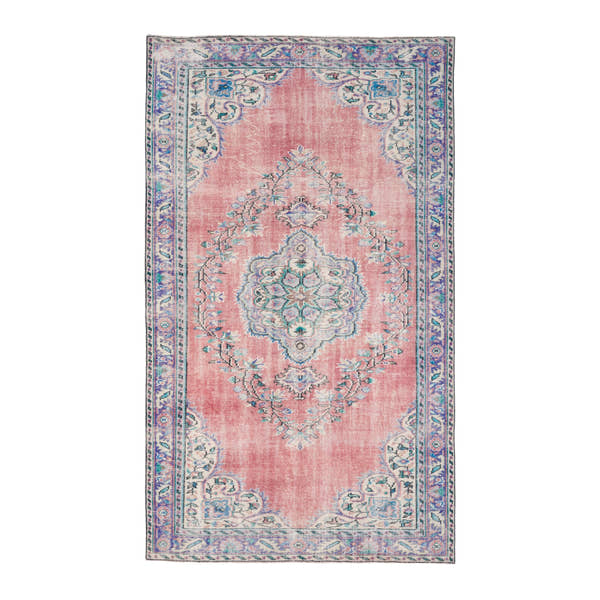
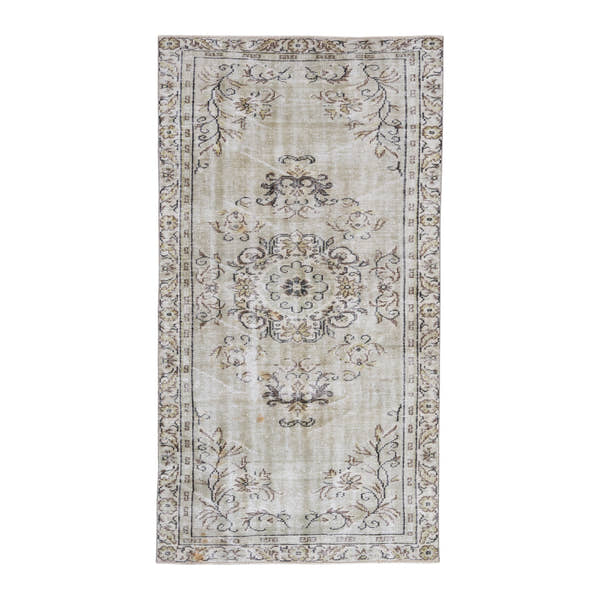


Manisa: soft, sun-faded weaving from western Turkey
Manisa lies inland from Izmir on the Aegean side of Turkey, in country that has been weaving for a very long time. Manisa carpets are the calmer relatives of the bolder Anatolian tribal weaves further east. The fields tend to be open, the palettes muted, and the drawing restrained. Where a central Anatolian rug shouts, a Manisa speaks at conversation level.
That restraint is what has made them so popular. A Manisa gives a room the texture and history of a hand-knotted carpet without introducing a strong pattern that has to be worked around.
The province lies inland from Izmir, with a long carpet tradition centered on the town of Demirci and the surrounding villages. Weaving there was a household craft, and the rugs carry the loose, confident drawing of pieces made without a workshop cartoon.
The wool is heavy and the pile is cut low, so Manisa rugs are comfortable underfoot without any bulk. Colors lean to cream and soft pinks, with some terracotta, faded red and turquoise, often faded to a soft, dusty finish. Designs mix medallions with tribal filler motifs and wide, simple borders.
Most of our Manisa pieces are area rugs, from about 5 x 8 feet up to the larger room sizes. They suit living rooms and bedrooms where the goal is warmth and texture rather than a formal centerpiece.
The Manisa look
- Palette: muted and sun-softened; cream above all, then dusty rose, soft pink, terracotta and the odd turquoise.
- Drawing: restrained medallions and open fields, often with generous borders.
- Wool: good Aegean wool, usually with a soft handle after decades of use.
- Sizes: almost all are room-size area rugs, from about 5 by 8 feet up to extra large; for a hallway, look at our runners instead.
Living with a Manisa
A Manisa is the rug to reach for when you want the floor to feel warm rather than decorated. It works particularly well in bedrooms and in rooms with a lot of wood, where the muted palette picks up the timber rather than arguing with it. In a living room, a large Manisa gives the seating a soft base without turning the floor into a feature.
They are also forgiving neighbors. If you already own a strong Persian rug in an adjoining room, a Manisa in the next space will not compete with it.
Age and the Manisa palette
Manisa colors were relatively soft to begin with, so age tends to unify rather than dramatically shift them. Reds move toward rose and dusty terracotta, and seen from a distance the whole rug comes close to a single warm neutral. Up close the individual colors are still clearly there.
Manisa questions, briefly
Is a muted rug a wasted opportunity in a plain room?
It depends what you want the room to do. A muted vintage rug in a plain room gives texture, age and warmth without committing the space to a color scheme, which is often the more useful outcome, particularly in a room you are still furnishing.
Will a Manisa look washed out next to strong furniture?
No, though it will work as a background rather than a focal point. If you want the rug to be the thing people notice, a bolder Anatolian or a deep Persian field is the better choice. If you want the furniture to be the thing people notice, a Manisa is exactly right.
Are these thin?
Every Manisa here has a low pile, which is normal for the region and one reason they are so easy to place under doors and furniture. Low pile in a hand-knotted rug is not a sign of thinness; the weight is in the dense knotting and the foundation.
Choosing among Manisas
Take the palette first, then the size. Because these look like neutrals from a distance, the more important decision is usually whether the rug is large enough for the room rather than which exact tone it carries. Each one is a single piece with its own history.
Isparta’s softer sibling, and why that is the whole appeal: the Manisa guide.