Oriental Carpets in Renaissance Paintings: Holbein, Lotto and the Table Carpet

Oriental carpets turn up again and again in Renaissance paintings, and most of them are Turkish carpets from Anatolia. Painters in Italy and northern Europe showed them draped over tables and hung on walls, because to own one was a sign of wealth. Several carpet designs are still named after the painters who recorded them: Holbein, Lotto, Memling and Ghirlandaio. The paintings show what those carpets looked like and how Europe used them, and their way of drawing still links them to the Anatolian rugs of the last century.
Why the carpets are in the paintings
Turkish carpets were the oriental carpets Western Europe knew best, because they had been imported from Turkey since at least the middle of the fifteenth century.[1] Carpets were a popular feature of Italian interiors, particularly in Venice with its trade links to the Middle East.[2]
Once they arrived, they rarely went on the floor. Carpets from the Islamic world were too precious to be walked on in Europe, so they were used to cover furniture or hung on walls.[3] That is why so many paintings show a carpet thrown over a table. A rug made in Anatolia for a floor became, in Europe, a table covering and a sign of its owner’s wealth and standing.[4]

The Holbein carpet
The Holbein carpet takes its name from a portrait by Hans Holbein the Younger that shows a similar carpet draped over a table.[5] Its pattern is built from small, knot-like medallions set in a network of diamond-shaped strapwork, and many later carpet patterns grew out of it.[5] These carpets were woven in Anatolia as early as the fourteenth century and became popular in Europe from the fifteenth century on.[5]
Holbein painted carpets with unusual care. In The Ambassadors, finished in 1533, a red Turkish carpet covers the upper shelf of the table between the two men, under globes and scientific instruments.[6] Up close you can see the individual knots, painted one by one, and the carpet rippling slightly at its edges.[6]


The Lotto carpet
Lotto carpets are easier to spot. Their field is filled with stylized yellow arabesques on a red ground.[7] They were made mainly for export in the western Turkish weaving center of Ushak, between the 1400s and the 1600s.[4] The name comes from the Venetian painter Lorenzo Lotto, who lived from 1480 to 1556 and often painted them.[4]
Lotto was far from the only painter to use them. Lotto carpets appear in some 200 paintings from the Netherlands alone during the sixteenth century.[4] The design stayed popular for more than a hundred years.[2] And Europeans displayed them on tables to preserve them, even though the carpets had been made for the floor.[4]
Memling, Ghirlandaio and the habit of naming
The habit did not stop with two painters. Certain carpet designs became known in Europe by the names of the artists who painted them.[1] Memling carpets are classical Anatolian carpets of the fifteenth and sixteenth centuries, named after the Netherlandish painter Hans Memling, who showed them in his religious works.[8] Ghirlandaio carpets are named for the Italian painter Domenico Ghirlandaio, in whose paintings they sometimes appear.[9]
The names are a convenience, not a statement about who designed the carpets. The paintings are simply a good record of what those carpets looked like and how Europeans lived with them. Who invented rugs goes further back, to the oldest carpet that does survive.
What links them to Anatolian rugs today
The geometric language of those early carpets did not disappear. The Met notes that many Shahsevan tribal weavings of the nineteenth and twentieth centuries, especially those with centralized geometric designs, show a striking relationship with Anatolian carpets of the fifteenth and sixteenth centuries.[8]
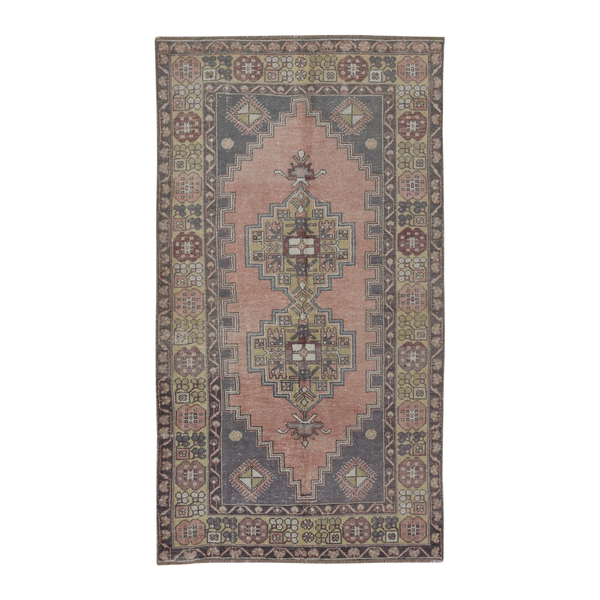
Our Anatolian rugs are village rugs from the twentieth century, not Renaissance carpets, and we would not pretend otherwise. What they share with the carpets in the paintings is that way of drawing: shapes built from steps and straight lines, often a medallion or two stacked down the field. The Anatolian rugs guide explains how to recognize one.

Living with one the Renaissance way
You can still use a rug the way those households did. A narrow rug laid along a long table, or folded over a side table, protects the wood and brings the pattern up to eye level. A low-pile rug works best for this, because it lies flat and things stand steadily on it. All of our rugs have a low pile. If you would rather put one on the wall, how to hang a rug on the wall shows how to do it without straining the rug.
On the floor, of course, a rug does what it was made to do. Ours are about fifty years old and were made to be walked on.

Where to see more
The carpets themselves are in museum collections, and the sources below link to some of them. For rugs you can live with, browse our Anatolian rugs or the wider Turkish collection, and read the ultimate guide to Turkish rugs for the regions. If you are unsure what the word oriental covers, oriental rug vs Persian rug explains it.
Sources
- Carpet fragments, Star Ushak pattern. Victoria and Albert Museum.
- Carpet, Lotto design. Victoria and Albert Museum.
- Carpets from the Islamic World, 1600-1800. The Metropolitan Museum of Art.
- Classical Turkish Carpet with the Lotto Pattern. Cleveland Museum of Art.
- “Holbein” Carpet. The Metropolitan Museum of Art.
- Hans Holbein the Younger, The Ambassadors. The National Gallery, London.
- “Lotto” Carpet. The Metropolitan Museum of Art.
- Portable Storage: The Tribes. The Metropolitan Museum of Art, 2017.
- “Ghirlandaio” Carpet. The Metropolitan Museum of Art.