Most articles on this question describe a designer’s taste. The part that actually decides the specification is duller and harder: whether the rug can be got, in that size, in that palette, in time, and whether there is a second one like it if the client says no. With vintage stock that last question has no good answer, and it changes everything upstream of it.
This is written from our side of the table — what we can and cannot supply — because that is the part a designer cannot see from the website.
Everything is one of one, and nothing can be reordered
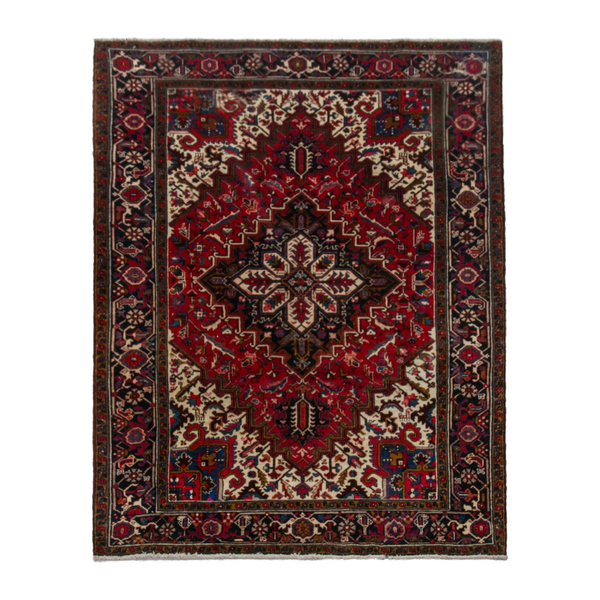
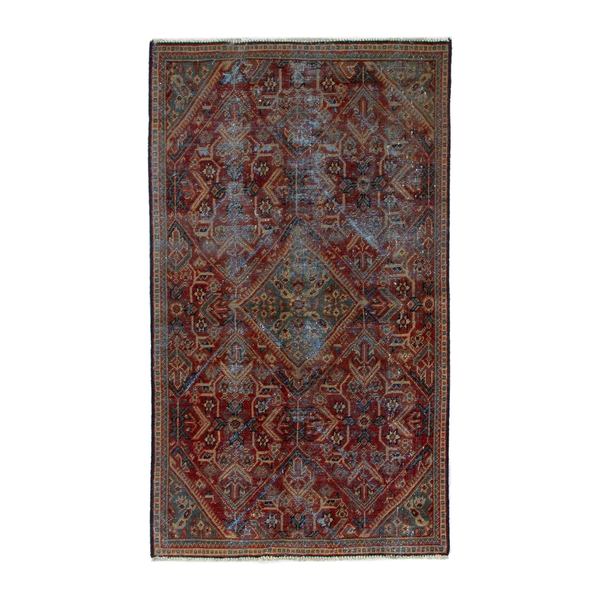
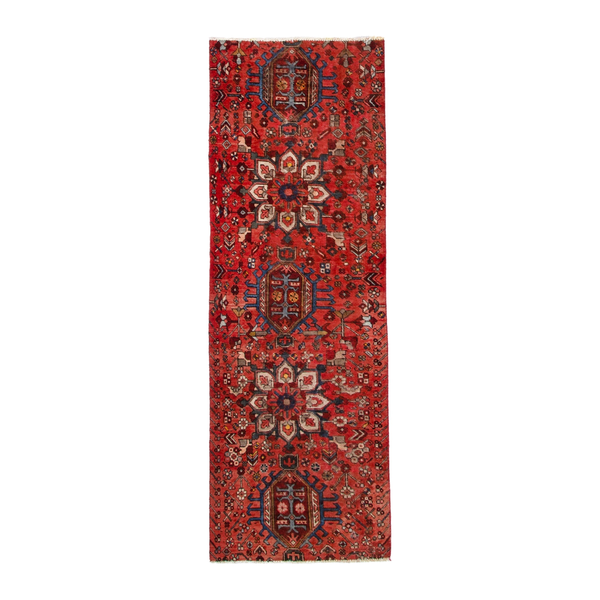
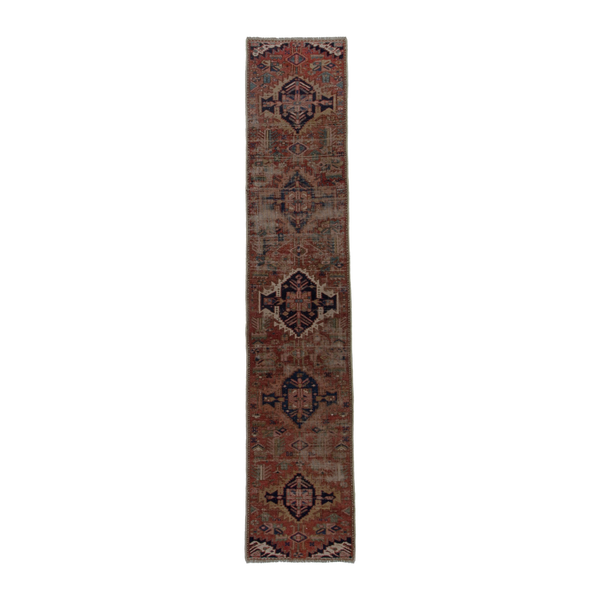
Every rug here is a single 1970s piece. If it sells while your client is deciding, it is gone, and there is no second one in a warehouse. That has three practical consequences for a spec:
- Specify early and hold. We can reserve a piece while a client decides — the terms are on the trade page. A reservation is worth more than a discount on this kind of stock.
- Always have a second and third option in the same palette. Not a fallback — a parallel. Which is possible in some size bands and genuinely not in others, below.
- Photograph what you present. Our listing photos are the only ones that exist for that rug. When it sells, the page goes, and so does your reference image.
Size first, and know where the stock is deep
Sizing a rug to a room is the one part of this that is a rule rather than a judgement, and we wrote it up in the size guide. What that guide cannot tell you is where we can actually deliver alternates. Right now, across 2,857 measured rugs:
- 5×8 to 6×9 — 742 rugs. The deepest band we have. If your scheme lands here you will find three or four viable alternates in one palette, and it is also the best value on the site.
- 3×5 to 5×7 — 766 rugs. Equally deep. Runners and study rugs.
- Under 25 sq ft — 1,001 rugs. Accent pieces, entryways, bedsides. Never a sourcing problem.
- 8×10 to 9×12 — 179 rugs. Thin. Specify these first, not last.
- Over 110 sq ft — 169 rugs. Thinnest of all. If an open-plan scheme needs one of these, start here and build the room around it; you will not find a matched alternate. Placing a rug in an open plan covers the layout side.
Palette follows origin, not preference
This is the single most useful thing we can tell a designer working from our stock, because it converts a color brief straight into a search.
If the scheme is warm — reds, rust, burgundy, navy — go to the Persian side. Deep red leads 1,164 rugs there and burgundy another 800.
If the scheme is pale — cream, greige, dusty rose, taupe — go to the Turkish side. Cream leads 433 of 794, then greige 140, muted pink 136, taupe 106, dusty rose 92.
That split is not a buying preference of ours; it is what the two regions wove. Trying to source a genuinely pale Persian village rug or a saturated red Turkish one means fighting the stock instead of using it.
One thing to warn a client about: these are fifty-year-old dyes that have moved. A red has usually eased toward rose and a navy toward slate, evenly, across the whole rug. Why vintage colors age the way they do is the version to send a client who is worried the photo looks faded.
Construction, and why it belongs in the spec

Hand-tufted rugs are made with a gun that punches yarn through a backing cloth, which is then glued and covered with a second backing. They are quick to make and cheap, they shed for months, and the adhesive layer is what fails first — once it goes, the rug cannot be repaired in any meaningful way.

Hand-knotted rugs are tied knot by knot onto a warp, with no glue anywhere in the structure. That is the whole reason a 1970s rug is still serviceable and the reason it can be repaired rather than replaced. Everything we sell is hand-knotted; we set out the full comparison in hand-knotted versus machine-made.
It is worth writing the construction into the specification explicitly. On a residential job where the client will live with the rug for twenty years, it is the difference between an item and a repair schedule.
Pile, traffic and the boring questions
Almost everything we hold is low pile — 1,949 of 2,055 Persian rugs and all 794 Turkish ones. For a designer that is mostly good news: doors clear it, dining chairs push back over it, and it reads flat in photography. It also means the drawing stays legible, which matters when the rug is doing the pattern work in an otherwise plain room.
Under furniture, and on any hard floor, specify a pad. We covered which pad suits which floor separately, including the vinyl warning that catches people out.
What to send us when you brief a rug
The brief that gets a useful answer back fastest has four things in it: the finished size range you can accept, the two or three colors that have to work, the floor it is going on, and the date the client decides. With those we can come back with a shortlist that is actually available rather than a mood board of rugs that sold last month.
Terms for trade accounts are on the trade page. If you would rather start by looking, the whole catalog is at every rug we have.