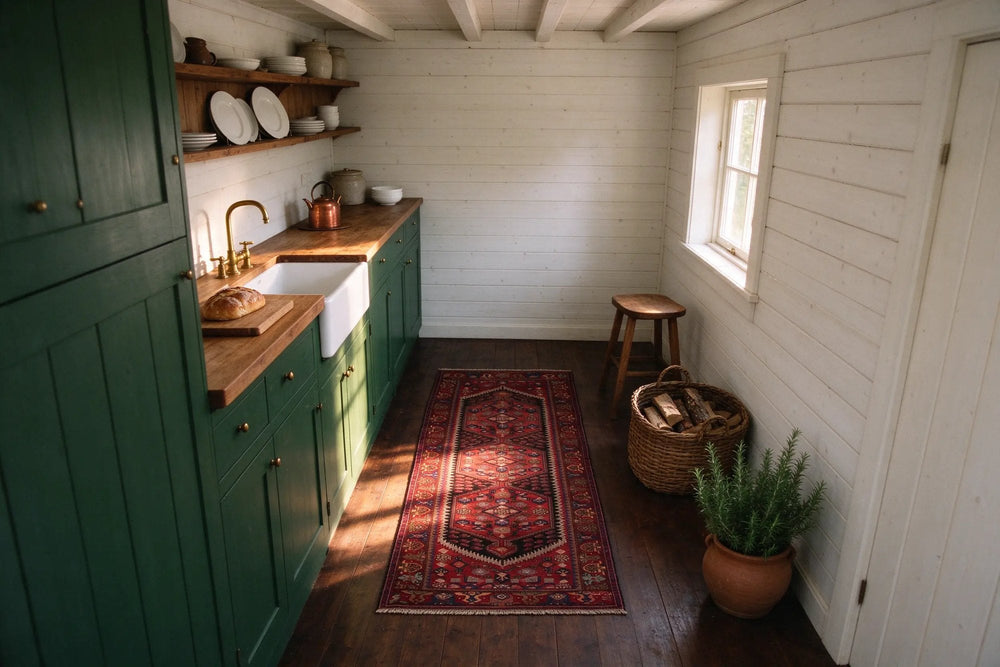
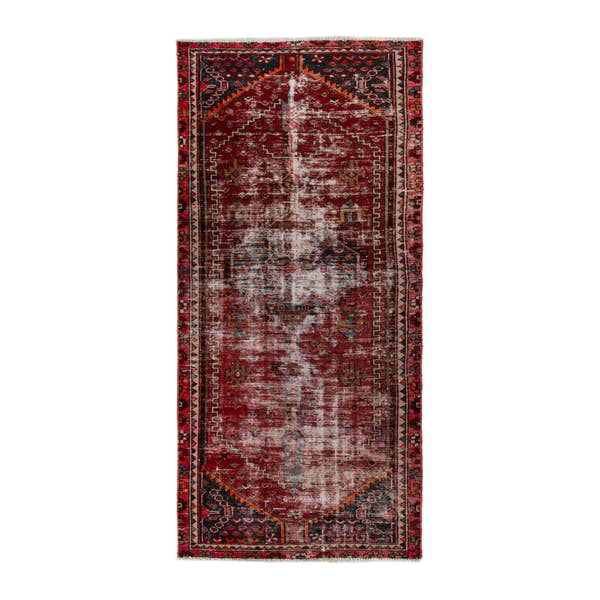
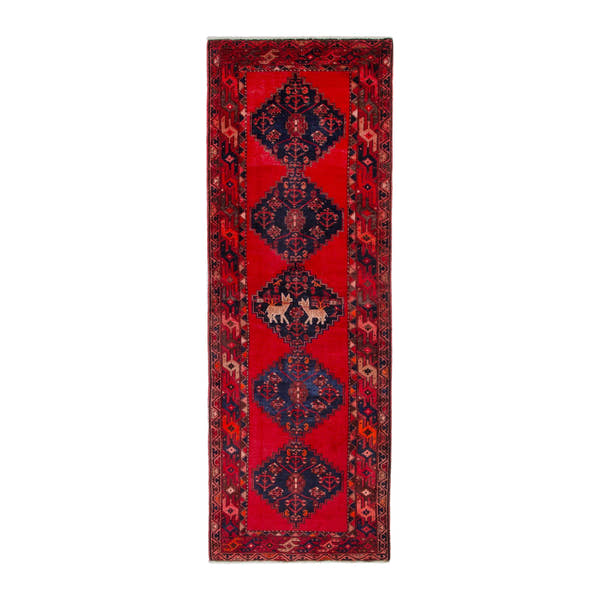
Zanjan is a province in northwestern Persia, on the road between Tehran and Tabriz. The rugs that carry its name are village work: modest in size, direct in color and made for use rather than display. Most of the Zanjan rugs you will find today are runners, around 3 feet wide. The rest are small rugs, from doormat size up to a 4 by 7, plus a few long, narrow pieces. Most of them are red.

What a Zanjan looks like
A Zanjan is drawn in straight lines. The medallion in the middle is a stepped diamond or hexagon, often with small hooks along its edges. On a runner you usually get two or three of these medallions in a row, sometimes linked by a thin pole. Around them the field is scattered with small stars, flowers and branches, all drawn with the same angular hand.

The weavers worked from memory, with no drawing on paper.[1] So the two ends of a Zanjan rarely match exactly. One medallion comes out a little wider than its twin, and a border squeezes to turn a corner. That is normal for village weaving, and it is part of the look.
Turn one over and you will see a cotton foundation, the white threads that run through the back and end in the fringe. The wool pile is low on most of them and feels firm under the hand.
The colors: deep red first
Deep red is the ground on most Zanjan rugs, and burgundy is the next most common. Cream, navy and dark blue appear in the borders and the medallion but rarely fill the field. A few are pale, with a cream, taupe or powder blue ground, but they are the exception. If you want a pale rug, the Turkish side is the better place to look; try Manisa instead.
The red is often madder, a dye made from a plant root, or a synthetic red that has aged the same way.[2] On a village rug the wool was usually dyed in small batches. That is why a Zanjan often shows abrash, a soft horizontal band where one batch of wool ran out and the next began.[3] It simply records how the rug was made, and our note on natural dyes explains why those bands age the way they do.

Sizes: mostly runners, nothing room size
Village looms in Zanjan were narrow, so the rugs are narrow too. Most Zanjan runners are 6 to 10 feet long, and a few reach 12 feet. That covers most hallways, the run of floor in front of kitchen counters and the side of a bed. Our guide to runner lengths for halls and kitchens explains how much bare floor to leave at each end.
The rugs that are not runners are small. A 3 by 6 is typical, and even the widest is only 4 and a half feet across. A Zanjan is rarely big enough to go under a sofa and chairs. For a living room, look at a room-size rug and use a Zanjan somewhere else.
That leaves plenty of good places for one. A Zanjan works beside a bed, just inside a door, in front of a sofa as a layer, or in a small study. For a front door, our post on entryway rug size helps you pick between a small rug and a runner.

Zanjan or Hamedan?
The two are easy to confuse, and they really are close. Both are village rugs from the west of Persia. Both sit on cotton, lean red and draw in straight lines. The name tells you where a rug was woven or traded. It does not change how you should judge it.
For a buyer, the practical difference is size. Hamedan villages wove a great many tiny mats as well as runners, so the Hamedan guide is the place to look if you want a 2 by 3. Zanjan gives you more runners and small rugs in between. If you want to know what the village label says about a rug, tribal, village and city rugs explains it.
What a Zanjan costs
Most Zanjan rugs cost between $300 and $800. The long runners and the few larger rugs sit at the top of the range, and the small rugs at the bottom. For a hand-knotted vintage village rug, that is plain, fair value. You are paying for wool, weaving time and fifty years of wear already proven, not for a famous name.
Caring for a Zanjan
A low, firm pile is easy to live with. Vacuum it with suction only, or with the beater bar raised, and keep the head off the fringe. Blot spills right away with a dry cloth, and never rub them.
Turn a runner end to end every six months or so. The end nearest the door takes most of the grit, and turning it spreads the wear. On a wood or tile floor, put a thin pad underneath, cut a little smaller than the rug, so it does not creep or bunch. Rug Pads 101 covers the choices, and our rug care page covers the rest.
You can browse every one in the Zanjan collection. If size matters more than origin, compare them with all our runners or the small and accent sizes from every region.


Sources
- Beyond Utility: Rugs of Southwest Persia. Georgia Museum of Art, University of Georgia.
- Storage Bag Faces (Art of the Islamic World, Image 39). The Metropolitan Museum of Art.
- The Ardabil Carpet. Victoria and Albert Museum, 2026.