Rug No. has found its new home.
Every rug we sell is one of a kind, so that piece is gone. Here are others in the same spirit, or tell Rug Finder what you are looking for.
Nahavand Rugs
Nahavand rugs on this page come from the Hamedan region of western Persia. Many are long, narrow area sizes around 5 by 10 feet, alongside small mats and a long runner, on near-black, deep red, burgundy, terracotta and navy grounds. Each one is hand-knotted and one of a kind, and the long shapes suit halls and narrow rooms.


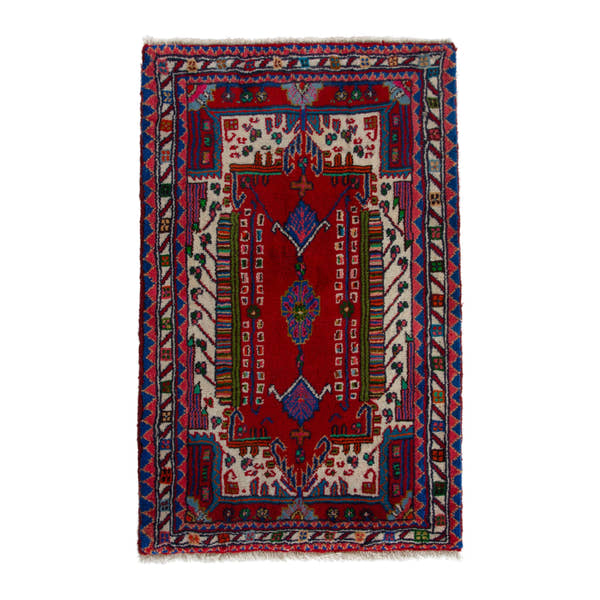

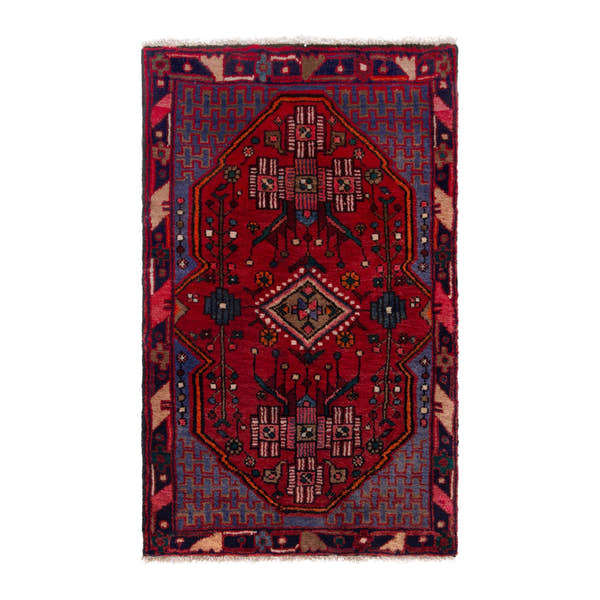

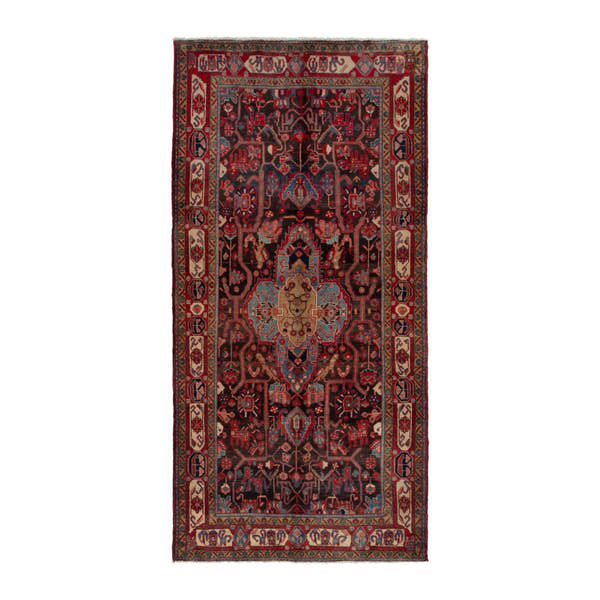


Nahavand rugs from the Hamedan villages
Hamedan, the market city for the villages around it, is built partly on the mound of Ecbatana, the capital of Media, founded by Greek account around 678 BCE. Rugs from the villages around Hamedan were taken to the city, long one of the great rug markets of Persia, and were often sold abroad under its name. Several generations ago many of these rugs were traded through Mosul, and so were known as Mosul rugs.
Nahavand is one of the town names that became known in its own right. The Battle of Nahavand in 642, fought between Arab and Sasanian forces, was a major turning point in Persian history.
What this collection holds
Many of our Nahavands share one shape: long and narrow, from about 4 by 8 feet to about 5 by 11. There are also small mats around 2 by 3 feet and a runner over 16 feet long. The grounds run dark and warm, near-black, deep red, burgundy and terracotta, with navy and tan among them. Every one is hand-knotted, with wool pile on a cotton foundation.
Where a long, narrow rug works
- A wide hall or landing: wider than a runner, so it covers more of the floor. See hallway and entry rugs.
- Beside a bed: one long rug can run the length of a king or queen bed.
- In front of a sofa or a kitchen counter: it follows the line of the furniture rather than filling the room.
- A long dining room: under a narrow table or along a sideboard.
Measure the space first and leave some bare floor at each end.
Our guide to choosing a runner length shows how much floor to leave at each end.
Living with a dark ground
Near-black and deep red grounds hide everyday wear well and give a pale floor a strong edge. They sit easily with dark wood and warm metals, and a terracotta or tan ground lightens the same look.
Caring for it
Vacuum in the direction of the pile, turn the rug every few months so sun and traffic reach every side, and blot spills straight away rather than rubbing them. Use a thin rug pad on hard floors so a small rug stays put. Our guide to cleaning a wool rug at home has the details.
Related collections
Read the Hamedan guide for the wider region, and browse Hamedan rugs, Toyserkan rugs, Malayer rugs and all runners.