A rug under a sectional should hold the front legs of both arms of the L and reach at least to the end of each arm. For a typical sectional of about 10 by 7 feet, a 6 by 9 is the smallest that works. An 8 by 10 or 8 by 11 fits comfortably. If you want the whole sectional on the rug, go to a 9 by 12 or larger. You do not need an L-shaped rug. An ordinary rectangle works.

Rug placement for a sectional
There are two good ways to place a rug under a sectional: with the front legs of both arms on it, or with every leg on it. The front-legs layout suits most rooms and needs the smaller rug. The all-legs layout needs a much larger rug, but it makes the whole sectional look settled. A rug that floats in front of the seats with no legs on it usually looks too small, as how to choose the right rug size explains. The sections below work through both layouts, then the chaise, the floating sectional and the U.
Front legs on the rug, on both sides of the L
The rule is the same as for any sofa: at least the front legs sit on the rug. A sectional has two fronts, one along each arm, so the rug has to reach under both. Tuck it about 6 inches under each seat front. That puts the rug’s inner corner under the corner seat, and the rug runs out from there into the room.
Then look at where the rug stops. Along each arm it should reach the end of the arm, or run a few inches past it. If the rug stops short on the long side, the last seat sits on bare floor and the sectional looks as if it is sliding off.
What size rug for a sectional
Take a sectional that is 10 feet along its long side and 7 feet along its short side, with seats about 38 inches deep. Tuck the rug 6 inches under both seat fronts, and its corner sits 32 inches out from the back of each arm.
- To reach the end of the long arm, the rug needs about 88 inches in that direction, just over 7 feet.
- To reach the end of the short arm, it needs about 52 inches in the other direction. It needs more if a coffee table and a chair sit across from the long side.
A 6 by 9 laid with its 9-foot side along the long arm just does it. It passes the end of each arm by about 20 inches and reaches the front legs of a chair across the coffee table. An 8 by 10 or an 8 by 11 does the same job with room to spare, and that is where we would start for most sectionals. Our post on 8x10 vs 9x12 works through the same sums for a straight sofa. With a sectional you do them twice, once for each arm.
Rug size by sectional size
Most sectionals take a rug from 8 by 10 to 9 by 12, and the length of each arm decides which. These sizes use the same seats, about 38 inches deep, as the example above.
- Small sectional, about 8 by 6 feet: a 5 by 8 holds the front legs. Choose a 6 by 9 if a chair sits across from the long side.
- Standard sectional, about 10 by 7 feet: a 6 by 9 at the least, an 8 by 10 or 8 by 11 for comfort, and a 9 by 12 to put every leg on the rug.
- Large sectional, about 12 by 9 feet: a 9 by 12 holds the front legs. For every leg, go to a 10 by 13 or a 10 by 14.
- U-shaped sectional: an oversized rug sized from the seat fronts, as described further down.
For the full list of standard sizes and their square footage, see standard rug sizes.

A rug under a sectional with a chaise
A sofa with a chaise works like a sectional whose short arm points into the room. The long side follows the usual rule. The rug tucks under its front legs and runs 6 inches or more past the far end. For the chaise, there are two good options.
The first is to put the whole chaise on the rug, legs and all. That needs a rug that reaches past the outer side of the chaise and past its foot. The second is to stop the rug alongside the chaise, so the chaise stands on bare floor and the rug runs down its inner edge. Avoid the layout in between, with one pair of chaise legs on the rug and one pair off. The chaise sits slightly unevenly, and the rug edge runs right under the seat people stretch out on.
For a sofa with a chaise about 9 to 10 feet long, a 9 by 12 usually takes the whole chaise with room to spare. If the rug stops beside the chaise instead, a 6 by 9 or an 8 by 10 is usually enough.
A sectional against the wall or floating in the room
A sectional tucked into a corner is the easy case. Its backs are against the walls, so the front-legs layout above is all you need. Leave the usual border of bare floor, 8 inches or more, between the rug and the walls.
A floating sectional has its back to the rest of the room, so people see the back of it. There are two clean layouts here. The rug can stop under the front legs, so the back of the sectional becomes the edge of the living area. Or the whole sectional can stand on the rug, with at least a foot of rug showing behind it.
What looks unfinished is a rug that goes under the back legs and stops right at the back of the sectional. So does a rug that shows only an inch or two behind it. From across the room, either one looks slightly too small for the sofa. In an open-plan room, a floating sectional often divides the living area from the dining area. Our post on placing a rug in an open-plan living space covers how the rugs in that room work together.

When to choose an oversized rug
Size up to a 9 by 12, a 9 by 13 or a 10 by 13 from the oversized rugs in these cases.
- The sectional is a U, with seats on three sides.
- The long arm is 12 feet or more.
- You want every leg on the rug, with a chair or two across from it as well.
- The sectional floats in a large open room, and the rug has to mark out the whole living area.
For a U, the rug sits inside the three arms and tucks under all three seat fronts. Its width is the distance between the two side seat fronts plus about a foot. It runs from 6 inches under the back seat to at least the ends of the side arms. Measure between the seat fronts, not between the backs.
Pattern and a pad underneath
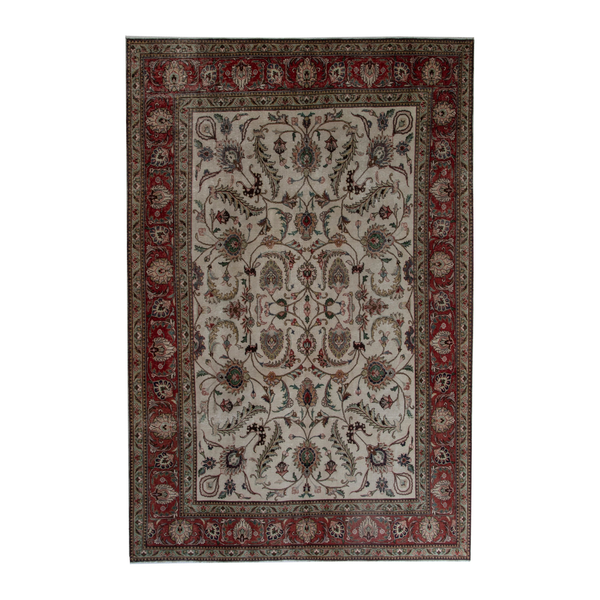
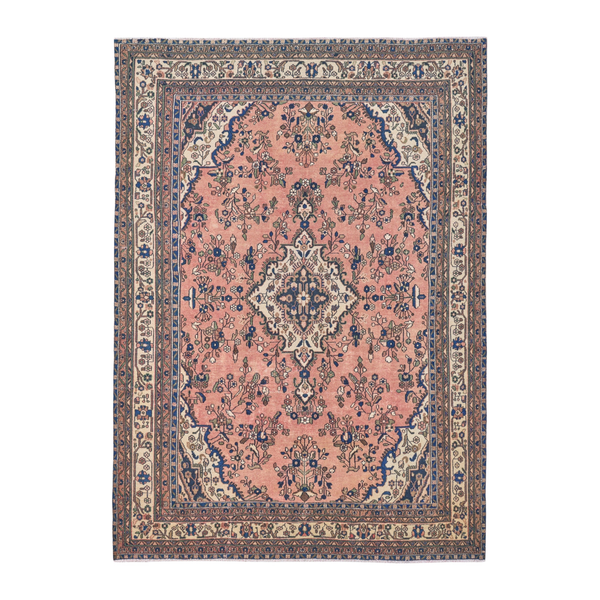
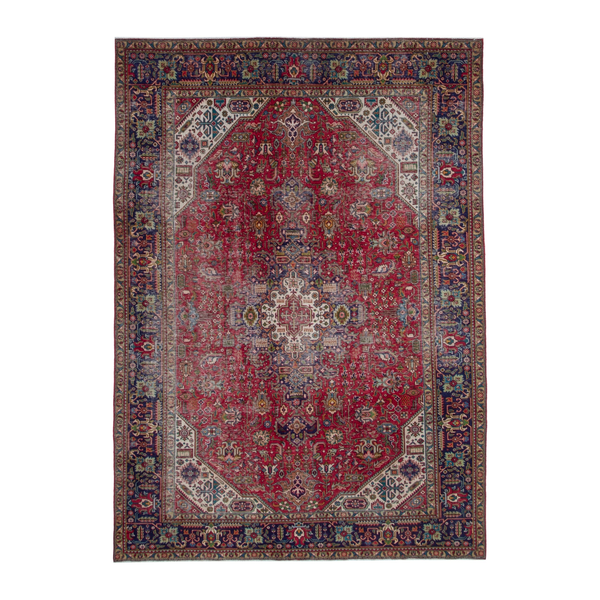
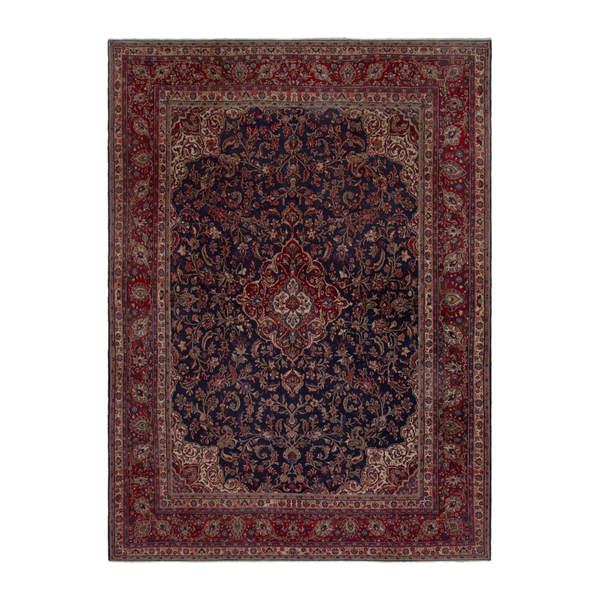
A sectional hides more of its rug than a sofa does, and it hides it unevenly. You see the inside of the L and the floor in front of it, which is off center on the rug. So a large central medallion can end up half under the coffee table and half under a seat. An all-over pattern, with the same motif repeated across the rug, has no center to lose.[1] That is why it suits a sectional so well. If you love a medallion, choose a rug large enough that the medallion lands in the open space. For the color question, see what color rug goes with your couch.
A heavy sectional anchors one side of the rug, and the open side is the one that creeps. A felt and rubber pad, cut about an inch smaller than the rug, holds the whole thing flat. Rug Pads 101 explains the options.

Before you buy
Mark the seat fronts on the floor with painter’s tape and measure from them, not from the backs of the sectional. Check that the rug reaches the end of each arm, and decide early whether the chaise goes on the rug or beside it. Every rug we list gives its exact size in feet, inches and centimeters. Start with the living room rugs, and use the size guide if you need to convert.
Sources
- Allover Definition & Meaning. Dictionary.com.