Rug No. has found its new home.
Every rug we sell is one of a kind, so that piece is gone. Here are others in the same spirit, or tell Rug Finder what you are looking for.
Hosseinabad Rugs
Hosseinabad is one of the many weaving villages in the Hamedan region of western Persia. The work is unpretentious village weaving: single-wefted, flat, and built for daily use.

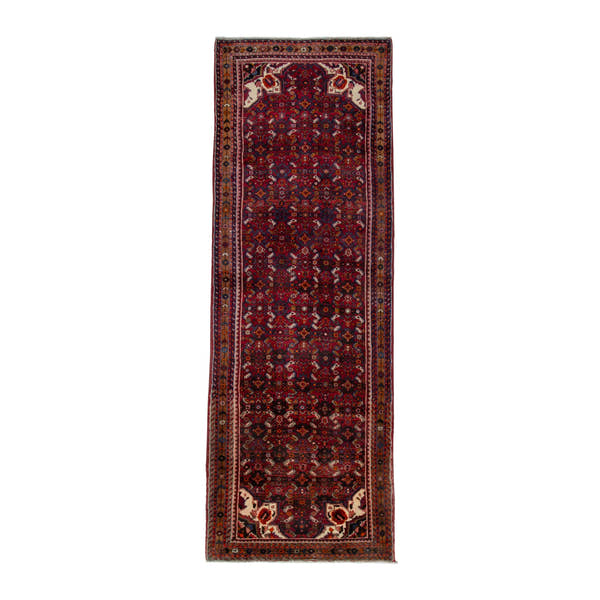


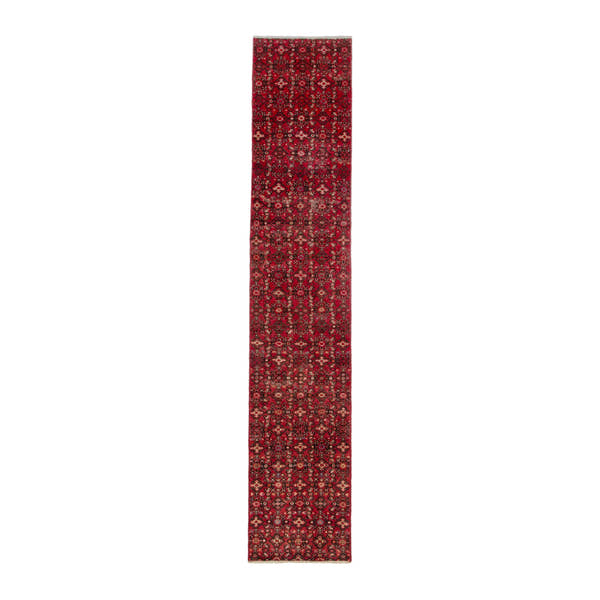

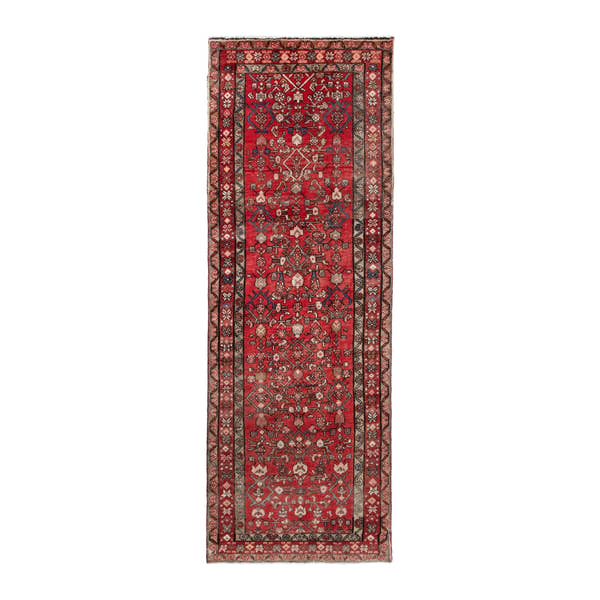


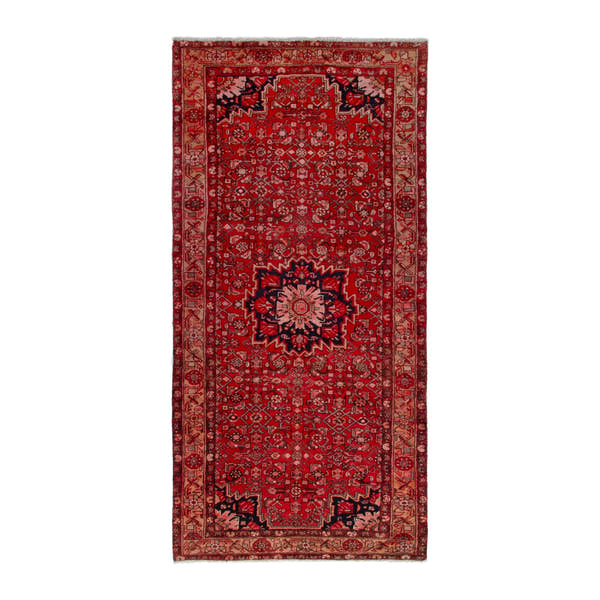

Hosseinabad: runners from the Hamedan villages
Hosseinabad is one of the many weaving villages spread across the Hamedan plain in western Persia. There are several places of the name in Persia, which is a reminder that this is village production rather than a famous workshop town, but the weaving is consistent and recognizable: single-wefted, flat, plainly geometric.
What the village is known for is runners. About half of this collection is long and narrow, which is what these villages wove in quantity for local houses with long corridors; the other half are area rugs for living spaces.
About half of what we carry from here are runners, which is what these villages wove most; the rest are room-size area rugs. Each was hand-knotted between the 1940s and the 1980s and has no twin.
Hosseinabad drawing and color
- Drawing: repeating boteh, stepped diamonds and hooked medallions running the length of the field.
- Color: deep red and burgundy grounds, with indigo, camel and ivory in the drawing.
- Construction: single-wefted, wool on cotton, mostly thin and flexible.
- Sizes: runners and room-size area rugs in roughly equal numbers.
The corridor rug
This is the collection to look at if you have a corridor. A repeating field means the runner does not look cut off wherever it ends, which is a common problem with a medallion runner in a hallway of the wrong length.
The thin single-wefted build also clears low doors, which matters more in a hallway than anywhere else in a house.
Why village runners are worth knowing about
Runners are the hardest shape to buy well. Most are either machine-made or cut down from larger carpets, and both show. A genuine village runner was woven as a runner, with a border that resolves properly at both ends and a field designed to repeat, and once you have seen the difference it is difficult to unsee.
Questions about Hosseinabad rugs
Is this a village or a district?
A village, within the wider Hamedan weaving region of western Persia.
How do I know a runner has not been cut down?
Look at both ends. An original runner has a complete border and finished ends; a cut-down carpet usually has a border that stops mid-pattern or has been reconstructed.
Does a thin runner need a pad?
On a hard floor, yes: use a thin rug pad. The flexibility that makes these rugs good for doorways also means they need a little grip underneath.
Measuring for one
For a runner, measure the corridor and allow a gap at each end rather than filling it wall to wall; for an area rug, measure the seating group it has to hold. Each rug here came off a village loom between the 1940s and the 1980s and is the only one of its kind. The Hosseinabad guide covers the village and how its weaving differs from the rest of the Hamedan plain.