Rug No. has found its new home.
Every rug we sell is one of a kind, so that piece is gone. Here are others in the same spirit, or tell Rug Finder what you are looking for.
Heriz Rugs
Heriz, in East Azerbaijan in northwest Persia, gives its name to one of the most durable and recognizable Persian carpets: a big angular medallion, strong cornerpieces, and a palette of madder red, indigo and ivory.
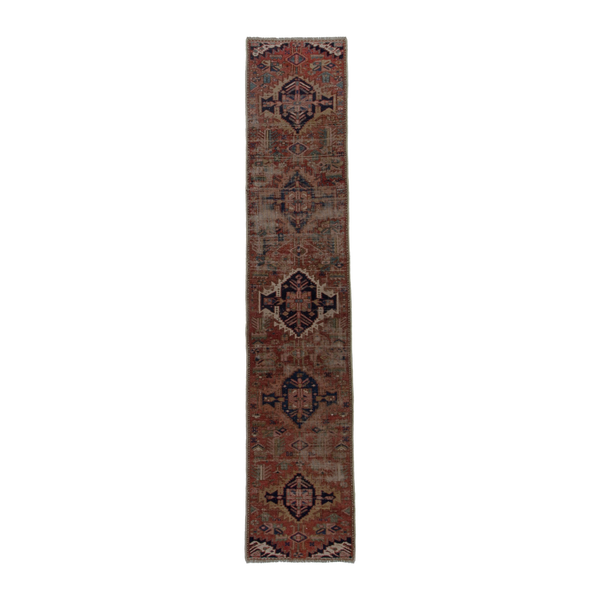
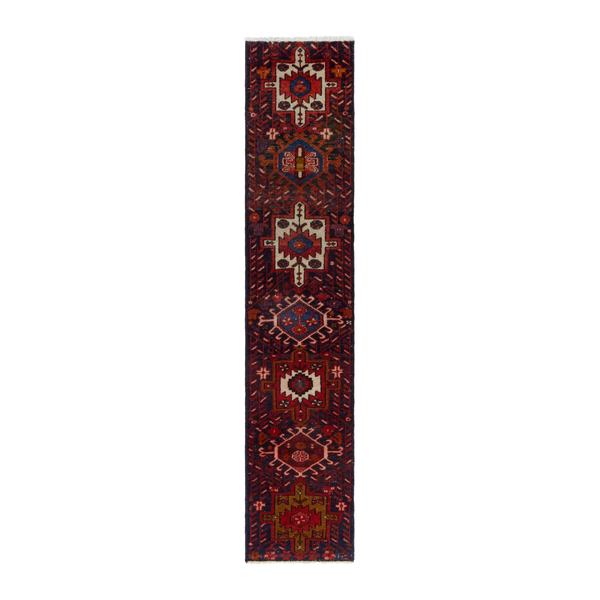
These are rugs built for hard use, which is why so many survive in good condition decades later. About half of ours are runners, and most come from the neighboring villages of Gharajeh and Gorevan; the rest are small mats and a smaller group of oversized and room-size carpets. Each was knotted between the 1940s and the 1980s and has no duplicate.
The district lies northeast of Tabriz, and its rugs are the great geometric carpets of Persia: a large angular medallion, stepped corners, and a field filled with stylized leaves and flowers drawn in straight lines rather than curves. The style is bold, and Western homes have prized it since the 1800s.
The wool is exceptionally hard-wearing, taken from sheep grazed at altitude, and the pile is cut low on a cotton foundation. Colors are strong: brick red, terracotta, deep blue, and a characteristic mix of ivory and salmon in the medallion. Heriz rugs are known to outlast most other carpets in high-traffic rooms.
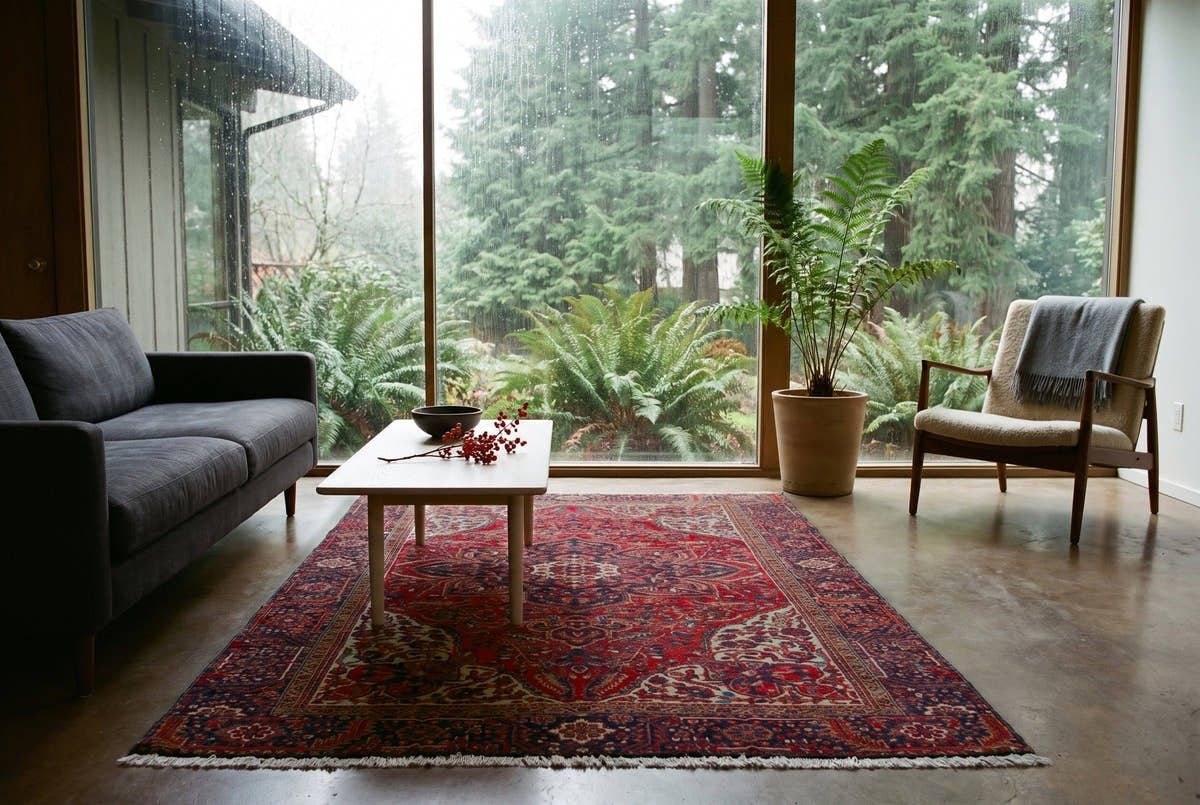
Our larger Heriz pieces are a natural fit for living rooms and dining rooms, and their geometric drawing sits comfortably with modern furniture.



Heriz: the carpet built to be walked on
Heriz sits east of Tabriz in East Azerbaijan, in the hills below Mount Sabalan, and it has given its name to one of the most recognizable carpets in the world. The design is unmistakable: a large angular medallion, strong corner brackets, and a field of stylized vines drawn in straight lines rather than curves. Where a Tabriz workshop drew a curved vine from a cartoon, a Heriz weaver squared it off.
The other half of the reputation is the wool. The sheep in this district produce a coarse, springy fleece, and the water used for washing is said to harden the dyes. Whatever the reason, Heriz carpets stand up to generations of use in a way that finer carpets do not.
Heriz at a glance
- Drawing: one big geometric medallion, squared corner pieces, angular vinework.
- Color: deep red and burgundy grounds, indigo medallions, ivory corners, with soft green and camel accents.
- Construction: low wool pile on a cotton foundation, medium knot count, heavy in the hand.
- Sizes: runners make up about half of ours, alongside small mats, oversized carpets and a few extra large room sizes.
Built for busy rooms
This is the rug for a room that gets used. A Heriz under a dining table, in an entrance hall or across a family living room will absorb years of traffic and look better for it, because the pile compacts rather than wears through.
The scale of the drawing also means a Heriz is easy to make out at a distance. It does not need to be studied up close to work, which is why it suits open-plan spaces and tall rooms.
Why the drawing is angular
Heriz weavers worked from memory and from village practice rather than from a paper cartoon. Curves are difficult to hold in the head across a nine-foot field; straight lines and steps are not. The angularity is not a simplification of a finer design, it is its own tradition, and it is the reason a Heriz looks confident rather than fussy.
Questions we hear about Heriz
Is a Heriz the same as a Serapi?
Serapi is a trade term for older, more finely woven Heriz district carpets, generally from before 1900. It describes a grade rather than a separate village. Everything here comes from the Heriz district: Heriz itself, Gharajeh and Gorevan.
Are Heriz rugs good for high traffic?
They are among the best. Tough local wool and a medium knot count are what have kept so many of them in daily use for generations.
Does Heriz only make large carpets?
No. The district wove large carpets for export to European and American houses, but it also made runners and small rugs, and those are most of what we have.
Narrowing the choice
Start with the shape of the floor, a hallway or a whole room, then look at the ground color, since that is what will set the temperature of the space. Every piece here is a vintage original from the Heriz district, professionally washed by specialists we have trusted for years, and the only one of its kind.
Deciding between the two great northwest weaves? Heriz vs Tabriz compared lays out the differences in drawing, knot and wool.
Three names on one shelf, and which of them suits which room: the Heriz guide.
This collection covers the whole Heriz district, including the village weaves of Gharajeh and Gorevan.