Saveh Rugs
Saveh, north of the central Persian plateau, turns out honest village rugs: firm geometry, dependable wool and warm reds and blues.
They were woven to be walked on, not admired from a distance. Every Saveh here is a genuine vintage piece, worn in gently and restored by hand.


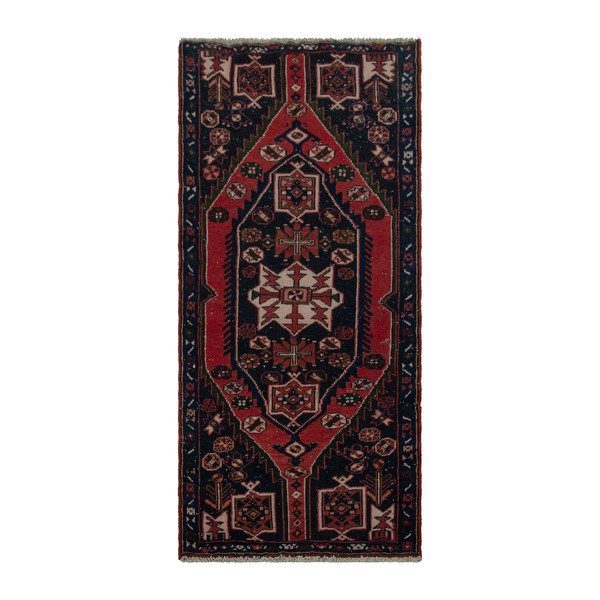


Saveh: sturdy village weaving from central Iran
Saveh lies south west of Tehran in central Iran, in country that produces solid, unfussy village carpets. Saveh weaving favours clear geometry on warm madder grounds, with the practical construction typical of the region: firm, hard wearing, and built for daily use.
What to look for
- Drawing: clear geometric medallions and repeating field motifs.
- Color: warm madder ground with indigo, ivory and camel.
- Weave: firm village construction on cotton.
- Sizes: good in runners and mid sizes.
Where they work
Saveh rugs are workhorses. They suit hallways, kitchens, family rooms and anywhere a fine carpet would be wasted. The warm ground and clear geometry take real life without complaint.
Village character
Expect abrash, slight irregularity in the borders and medallions that are not perfectly centered. These are hallmarks of genuine village weaving.
Saveh rug questions, answered
How does Saveh compare to Hamedan?
Very similar in spirit and construction. Both are practical central and western Iranian village weavings with strong geometry and good durability.
Are these good value?
They are among the more sensibly priced genuine hand knotted Persian rugs, largely because they are village rather than workshop pieces.
Getting the size right
Saveh weaving is at its best in the sizes it was made for. Runners want to leave roughly a hand's width of floor on each side of a corridor rather than filling it wall to wall, which keeps the rug reading as an object rather than as fitted carpet. In a family room, aim for a piece large enough that the front legs of the seating sit on it; a rug floating in the middle of a room with all the furniture off it is the single most common sizing mistake, and it makes both the rug and the room look smaller.
Looking after a village carpet
These are among the easiest rugs to live with. Vacuum without a beater bar, turn the rug end for end once a year so the light and the footfall move around, and use a pad underneath, which does far more for the life of a rug than anything else. Deal with spills by blotting rather than rubbing. Wool has a natural resistance that gives you more time than you expect. Professional cleaning every few years is plenty; nothing here needs anything more elaborate.
What to check before you buy
Look at the photographs of the ends and the sides, which is where a rug shows its age first. Some wear to the pile along a traffic line is normal and expected on a vintage carpet and is not a problem. Every piece here has already been washed, inspected and, where needed, repaired by our restorers before it was listed, and the condition notes on each rug tell you what we found.
Choosing your Saveh
Size first, then the strength of the ground color. Each rug is one of a kind.