Rug No. has found its new home.
Every rug we sell is one of a kind, so that piece is gone. Here are others in the same spirit, or tell Rug Finder what you are looking for.
Turkish Rugs
Turkish rugs on this page come mostly from the workshop towns of Isparta and Manisa in western Turkey, with a small group of Anatolian village pieces alongside them.
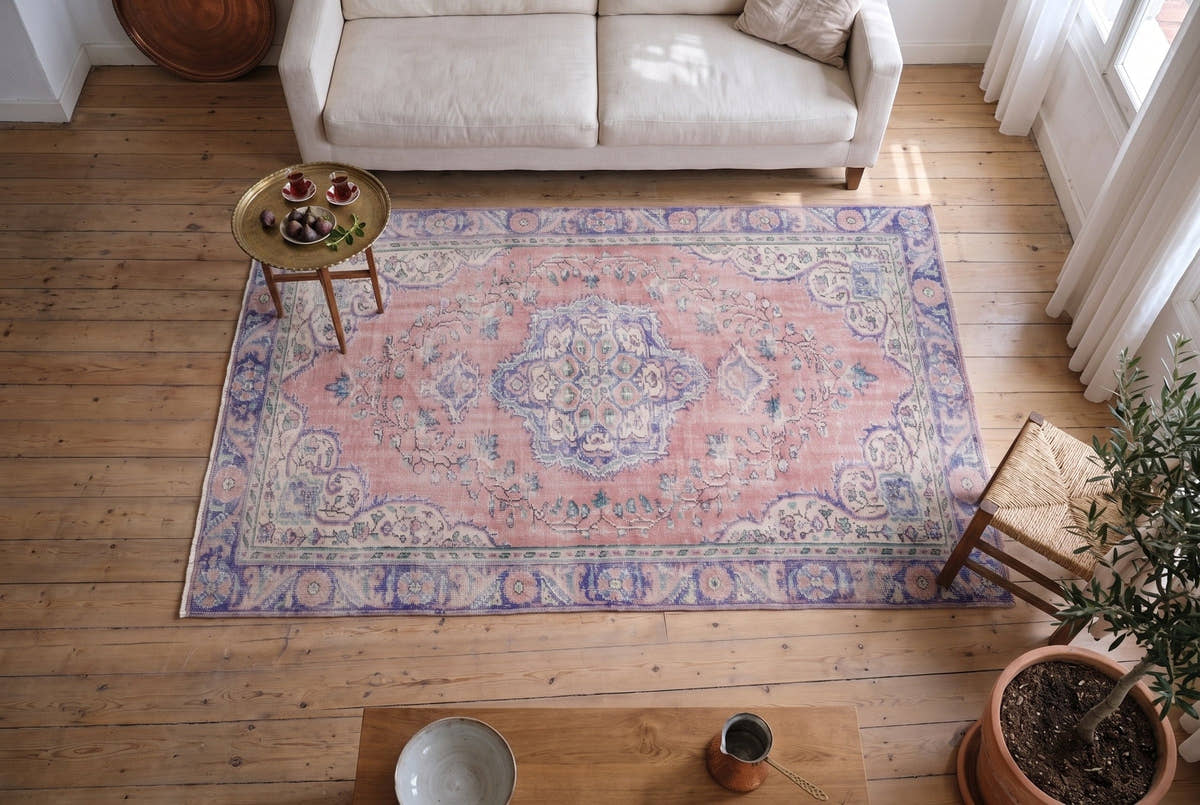
They are tied with the symmetrical Turkish knot, which gives their medallions and stepped borders a clean, graphic edge. Most sit on cream and ivory grounds, and many have softened over decades into dusty rose and muted pink. Follow the weave that speaks loudest to you.


Turkish rugs: one country, many looms
Turkish rugs cover more ground than any single style suggests. Turkey’s weaving stretches from refined town workshops in the west to village and tribal looms across the Anatolian plateau, and most of this collection comes from those western workshop towns: vintage carpets knotted in the 1970s and worn soft by real use. What ties them together is the symmetrical Turkish, or Ghiordes, knot, looped around two warps to produce the crisp, upright geometry the tradition is known for.
Town and city weaves
The workshop towns of western Turkey produced the country’s most polished carpets. Isparta looms in the southwest turned out room-size rugs with open medallions and soft, easy-to-place color, while Manisa near the Aegean is known for elegant, restrained pieces that sit comfortably in calm, modern interiors. These are the Turkish rugs that lean formal, balanced and generously sized, at ease filling a living or dining room.
Village and tribal Anatolia
Inland, the character changes completely. Across the Anatolian heartland, weavers worked on home looms and from memory, producing bolder, more improvisational rugs: stepped medallions, prayer niches, protective symbols and palettes pulled straight from local plants. If that folk side is what draws you, the dedicated Anatolian collection gathers the village and tribal pieces in one place. Konya and Ladik prayer rugs and the tribal weaves of the eastern highlands belong to this half of the Turkish story too, though our own Anatolian pieces are a small group.
Reading color and pattern
Much of the enduring appeal is what time does to Turkish dye work. Years of light and footfall have softened these palettes into cream and ivory grounds with dusty rose, muted pink and faded red, tones that flatter both inherited furniture and pared-back contemporary rooms. Because the patterns are built from straight lines and repeats rather than fine floral scrolls, they look like texture at a distance and show their detail up close. That mix of strong structure and gentle color is exactly why Turkish rugs sit so well in layered, collected interiors.
A quick guide to telling them apart
- Town versus village: even, high-density knotting behind a formal medallion usually signals a workshop rug; looser knotting and a wandering pattern point to a village loom.
- The knot: flip a corner. A symmetrical knot wrapping two warps is the Turkish signature and the reason the geometry looks so crisp.
- Palette: the Isparta and Manisa pieces here mostly sit on cream or ivory, often with dusty rose and muted pink worked through the design.
- Wool quality: well-made vintage Turkish wool often has a faint sheen and real weight in the hand.
Placing one at home
Because the category is so broad, there is a Turkish rug for almost any spot. Reach for an Isparta or Manisa when you need to fill a whole room and want the pattern to breathe; choose a smaller Isparta or Manisa piece, or one of the Anatolian village rugs, when a hallway, kitchen or landing needs a lift. Use a rug pad underneath, rotate the rug a couple of times a year, and vacuum without a hard beater bar. Wool that has already lasted this long asks very little of you. If you are unsure which scale fits, the size guide is a sensible first stop.
Common questions
How is this collection different from the Anatolian one?
This page holds every Turkish rug we carry, town and country together, though most are refined workshop weaves from Isparta and Manisa. The Anatolian collection is the narrower village-and-tribal group from the interior. If you are torn, browse both; plenty of rugs would suit either room.
Why are so many of these rugs cream and pink?
The Isparta and Manisa workshops favored light grounds and soft rose tones, and fifty-odd years of use have gentled them further. Cream is the most common ground here, with dusty rose and muted pink close behind.
Which Turkish rugs suit a modern room best?
Isparta carpets, with their open fields and soft palettes, tend to sit most easily in contemporary spaces, while a restrained Manisa piece adds pattern without fighting clean lines.
Each carpet here is an original, washed by specialists we have trusted for years before it was listed; our about page tells the rest of that story. When a rug sells it is gone for good, so trust the piece that keeps pulling your eye back.
Not sure which tradition you are looking at? Persian and Turkish rugs: how to tell them apart goes through the tells, from knot to palette.
Region by region, what separates one Turkish weave from the next and what each one costs: the ultimate guide to Turkish rugs.