Patterned Rugs
Patterned rugs cover the whole field with a repeating design instead of building to one central point, trailing florals, diamond lattices, the herati fish, tidy rows of boteh paisley.
The interest runs edge to edge, which is exactly why a busy field shrugs off crumbs, paw prints and everyday traffic. Each is a vintage original, hand-knotted in wool in the 1970s, then cleaned and restored. Follow the repeat that suits your room.
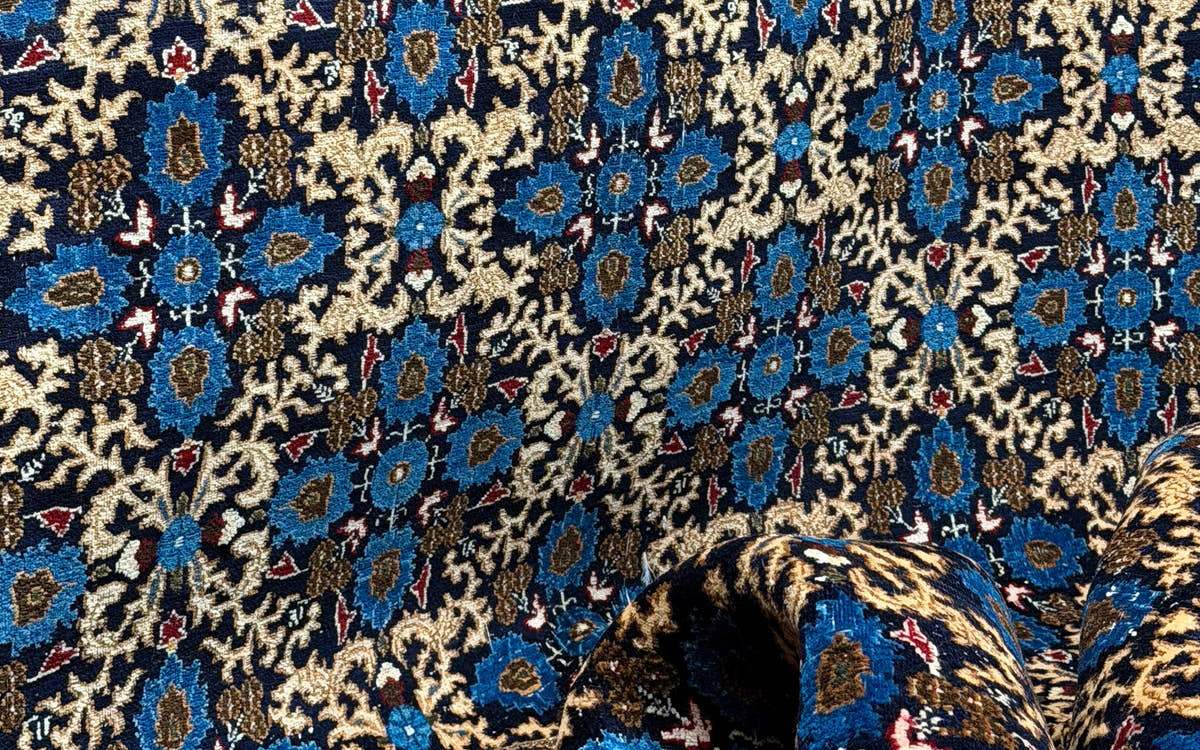


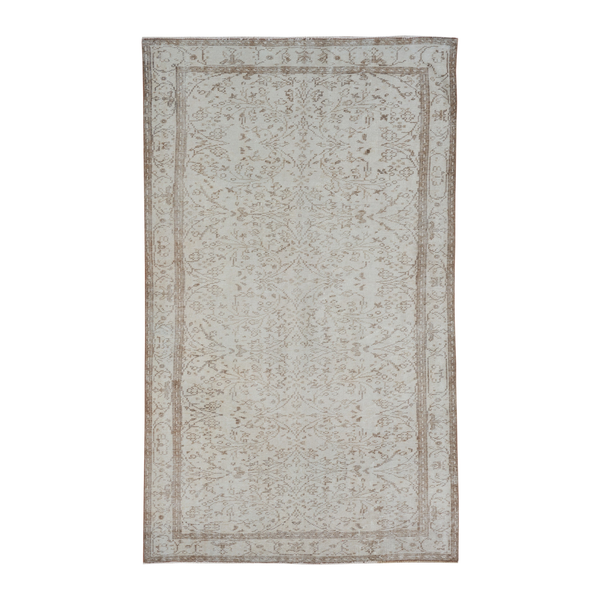


Patterned rugs, edge to edge
Patterned rugs carry a design that repeats across the entire field instead of resolving into one central figure. The motif, a flower head, a leaf, a paisley, a node in a lattice, is drawn once and then echoed in every direction until it meets the border. The result is a floor with even weight and no empty space: rich to study up close, calm from across the room. Every piece in this collection was hand-knotted in wool decades ago, so no two repeats are ever quite identical.
A short glossary of the motifs
- Herati: a rosette inside a diamond, flanked by four curved leaves that read like fish. The most widespread all-over pattern in Persian weaving.
- Boteh: the bent teardrop that grew into the paisley, set in tidy marching rows across the field.
- Mille-fleurs and garden: a thousand small blossoms packed edge to edge, often on a deep, saturated ground.
- Lattice and gul: geometric grids and repeated tribal medallions that keep the field structured yet open.
Each carries a different mood, so it pays to look closely at the field rather than judge a rug by its outline alone.
Why an all-over field is the practical choice
A busy pattern is the hardest-working surface you can put on a floor. Because the eye takes in the whole field rather than one clean center, a dropped crumb, a coffee ring or a set of paw prints simply melts into the design until the next tidy-up. Add the natural resilience of hand-spun wool and you have a rug built for the rooms where life actually happens, kitchens, family rooms, halls and dining spaces. If you want a deep, warm ground that hides the most, the reds and rusts among our red rugs reward a closer look.
Pattern against pattern, without the clash
An all-over rug is happiest when the room gives it space to breathe. A few working rules:
- Keep upholstery plain or lightly textured, and let the rug be the loudest thing on show.
- Pull a single color out of the field and repeat it in cushions or curtains to tie the scheme together.
- In a small room, choose a repeat with an open ground so the floor stays lively rather than crowded.
- In a large or cool room, a densely packed field adds warmth and a welcome sense of enclosure.
All-over pattern, or a single center?
If you catch yourself wanting the eye to land in one spot, under a dining table, in the middle of a seating group, you may in fact be after a medallion rug instead. Patterned rugs do the opposite job: they spread interest evenly and ask nothing in particular of the furniture around them. Many of the finest examples come from the same weaving regions, so it is worth browsing our Persian rugs alongside this collection to compare the two approaches side by side.
Where the patterns were woven
An all-over field is not one tradition but many. Village looms across Persia turned out herati and boteh grounds by the yard, each weaver working the repeat from memory, which is why the drawing wanders and breathes rather than snapping to a printed grid. Town workshops answered with denser floral repeats and finer knotting. Anatolian weavers favored bolder geometry and repeated medallions strung across the field. When you scan this collection you are really scanning a map: a loose, sun-warmed Mahal reads quite differently from a crisp, tightly packed Sarouk, though both fill the floor edge to edge. Sorting by color is often the fastest route to the rhythm you are after.
What decades of use bring
These rugs are vintage, hand-knotted in the 1970s, and time has treated them well. Wool that has been walked on for a generation takes on a soft sheen, and older dyes mellow into the gentle, slightly uneven tones collectors prize. An all-over field disguises its own wear better than any other layout, which is part of why so many have survived in such good order. Each has been cleaned and, where needed, restored in our workshop, then photographed exactly as it stands today, the only one of its kind, ready for the next room.
Curious what the drawing actually says? Reading a rug: motifs and what they mean explains the figures that come up again and again in these fields.