Persian Rugs
Persian rugs come from the great weaving centers of Iran, where cities, villages and tribal camps have each developed their own hand of the loom.
Expect finely drawn medallions from Tabriz and Kashan, the rust geometry of Heriz, the sturdy village knotting of Hamedan and Bakhtiari, and the deep, settled palette that old Persian weaving is known for. Every piece here has already spent decades on a real floor. Choose the one whose story fits your room.
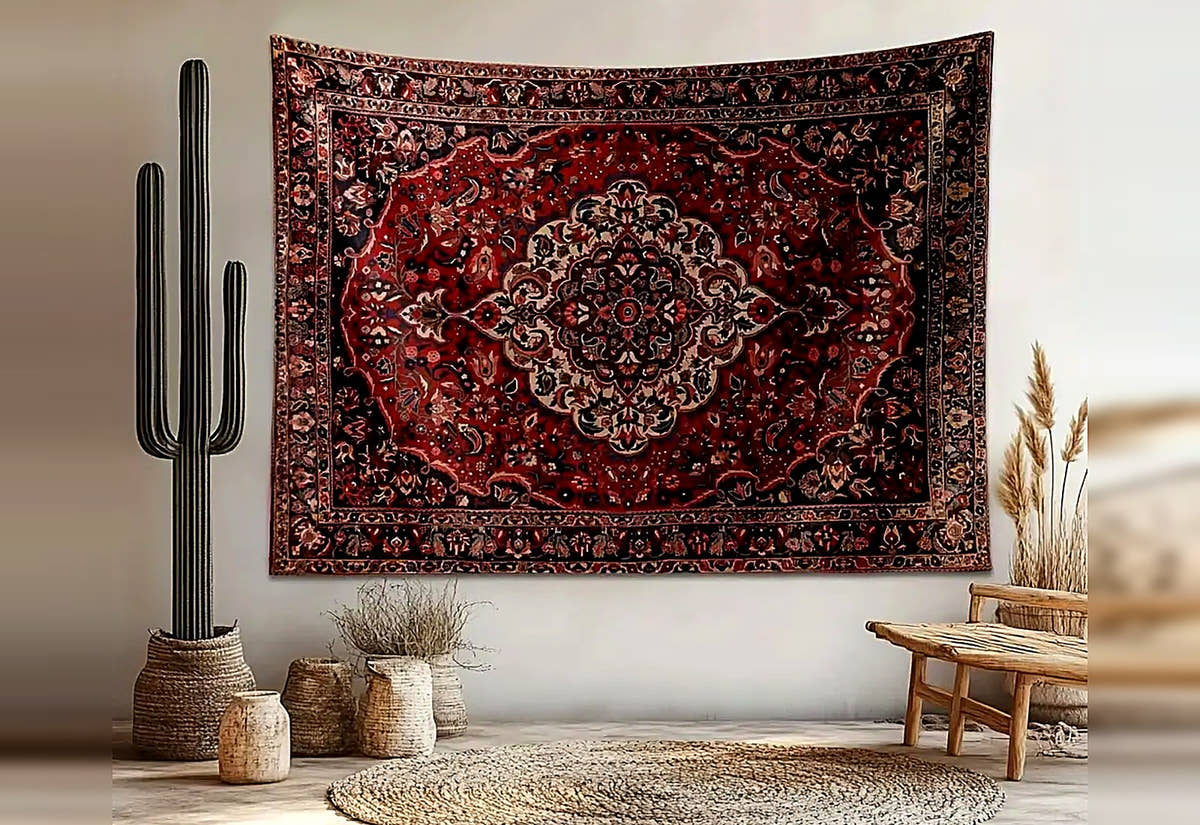


Why Persian rugs remain the benchmark
Persian rugs are the pieces every other hand-knotted carpet is measured against, and the vintage examples gathered here show why. Each was tied by hand on an upright loom somewhere in Iran, knot by knot, in wool. What arrives on your floor is the sum of that work plus forty to eighty years of ordinary life, colors that have mellowed, a pile that has been walked into a soft sheen, and small irregularities that mark a carpet made by a person rather than a machine.
A map of Iran’s weaving regions
Persian weaving is really a cluster of regional hands, and once you can read them, choosing gets easier. City workshops produced the most formal designs: Tabriz for crisp, tightly drawn medallions, Kashan for dense floral fields in deep red and ivory, and Mashhad for large, softly colored carpets from the east. Country weaving has a different temperament, Heriz turns its medallions into bold rust-and-navy geometry, while Hamedan villages knot sturdy, single-wefted rugs built for daily use. Tribal groups such as the Bakhtiari weave garden-panel grids and folk motifs that owe nothing to a city drawing office.
Knots, dyes and the logic of the pattern
Most Persian rugs use the asymmetrical, or Senneh, knot, which wraps around a single warp and lets a weaver follow the tight curves of a floral vine. That is why the tradition is so at home with curvilinear medallions, spandrels and arabesques, though geometric village work is common too. The palette almost always begins with plant and insect dyes: madder for warm reds, indigo for blues that shade from midnight to slate, weld and vine for yellows and greens. Because the wool was dyed in small batches, you will often see abrash, a gentle horizontal shift in tone, running across the field. It is a fingerprint of hand-dyeing, not a fault.
How to recognize a hand-knotted original
- Turn it over. The pattern should read clearly on the back, with individual knots visible rather than a printed or glued grid.
- Check the fringe. On a true hand-knotted rug the fringe is an extension of the warp threads, not sewn on afterwards.
- Look for abrash. Subtle bands of color change point to natural, small-batch dyeing.
- Feel the handle. Old wool carries weight and a slight lanolin softness that reproductions rarely capture.
- Expect small asymmetries. A border that adjusts its rhythm or a medallion set a touch off-center is the mark of a human weaver.
Living with your rug
These carpets were built for busy households, so there is little to fear. Lay a felt-and-rubber pad underneath to stop slipping and cushion the pile, and turn the rug end for end once or twice a year so foot traffic and sunlight wear it evenly. Vacuum with the suction head rather than a spinning beater bar, and blot spills with a cloth instead of scrubbing. A dense Persian weave hides crumbs, paw prints and the odd accident far better than a plain modern rug, which is part of why these pieces stay in family use for generations. If you are matching a carpet to a particular space, our size guide walks through the proportions worth measuring first.
Questions buyers ask about Persian rugs
Which region should I start with?
For a formal, symmetrical look, begin with a city weave such as Tabriz or Kashan. If you want something that shrugs off a busy room, Heriz and Hamedan village rugs are hard to beat, and their geometry suits contemporary interiors as readily as traditional ones.
Vintage or antique, which are these?
Everything we carry is vintage: hand-knotted in the 1970s, so roughly fifty years old. Antique normally means around a century or more, and we do not stock pieces that old. Vintage is the sweet spot for living with a rug, old enough for the colour to have settled, young enough to put on the floor without worrying.
Are tribal pieces less refined than city rugs?
They are different rather than lesser. City rugs prize precision and high knot counts; tribal and village rugs such as Bakhtiari prize expressive drawing and hard-wearing wool. Many collectors find the country weaves the more characterful of the two.
Every rug in this collection is a single, restored original photographed in our own studio, and once one sells it does not come back. New pieces join new arrivals regularly, so it is worth looking again if today’s search does not turn up your rug.
For a closer look at one of the great north west Persian weaves, read the story of Heriz.
New to buying vintage? What makes a vintage rug worth keeping covers what to look for and what ages well.